A New League Table of Maces at Universities
It’s been graduation season over recent weeks at many universities and it is always a special time in the academic calendar. Of course a big part of graduation is the ritual, the academic gowns, hoods and headgear, the strange language and, of course, the regalia. Specifically, the place of the university mace. The mace is an essential part of proceedings at many university graduations and has a long history.
The origins of these items is of course as weapons of warfare before they evolved into symbols of power. Monarchs in England and the UK have had them for centuries and there are plenty locked away in the Tower of London with the other crown jewels. There are many civic examples around the country too as well as the famous one in the House of Commons swung a few times by MPs keen to make a point before being suspended.
Whilst a few universities have maces dating back hundreds of years, most are a little more recent but they are all a key part of university identity these days, almost as important as the logo and the branded hoodie.
But, I hear you asking, which are the BEST maces? Which universities have the very finest silverware on sticks? It’s time to unveil the very first UK ranking of university maces.
As you would expect with such distinctive items, establishing clear criteria is challenging so we have rated each university mace against the following:
- Style and flamboyance
- Craftspersonship
- Back story
- Insurance value
- Heft
So which university maces will measure up most impressively and achieve the best overall score? Let’s find out.
University Mace league table
10 University of Liverpool
The Liverpool Mace:
is just under four-foot-long, sterling silver with a gilt cup shaped head, heraldic crown and surmounted by monde and cross. It was crafted in the early 20th Century 1907-1908 by the prominent silver smith Elkington & Co of Birmingham. It was commissioned by Dr Richard Caton on the occasion of his mayoralty. He was Professor of Physiology from 1872 and his work was crucial in discovering the electrical nature of the brain, which laid the groundwork for the discovery of the alpha wave activity in the brain. He became Pro-vice-chancellor of University of Liverpool 1921-4 and was also Lord Mayor of Liverpool (1907–08).

9 Dundee University
St Andrews, which appears elsewhere in the ranking, clearly felt that others should have maces too:
When University College Dundee was founded in 1881, it did not have university status. Students had to go to St Andrews for their exams, and it was only St Andrews that was able to confer degrees. It wasn’t until we became an independent institution in 1967 that we were able to do this ourselves.

In 1911, the University of St Andrews celebrated its 500th anniversary with a grand procession through the town. Each St Andrews college had its own mace, and to demonstrate that Dundee was a worthy equal, it was decided that UCD should also be given its own mace. This was made possible due to the generosity of Dr Rudolph Polack, president of Dundee’s Chamber of Commerce.
8 University of the Highlands and Islands
One of the newer maces, this one was a gift from other institutions and has to be flown from island to island for graduations:
Gifted by the universities of Edinburgh, Aberdeen and Strathclyde, the University of the Highlands and Islands mace was designed by Edinburgh College of Art’s jewellery and silversmithing department, and made by Edinburgh silversmiths Hamilton and Inches.

The mace is made from silver and wood – with indigenous Scottish light ash for the shaft – and some gold and mixed metals in the detail. The ornamentation symbolises sand or beaches, water and air, while the lower mount is adorned with three 18ct yellow gold wires depicting mountains. A concave plate is mounted at the very bottom of the mace, reflecting the theme of water and waves.
7 University of Glasgow
Glasgow’s mace has some real history:
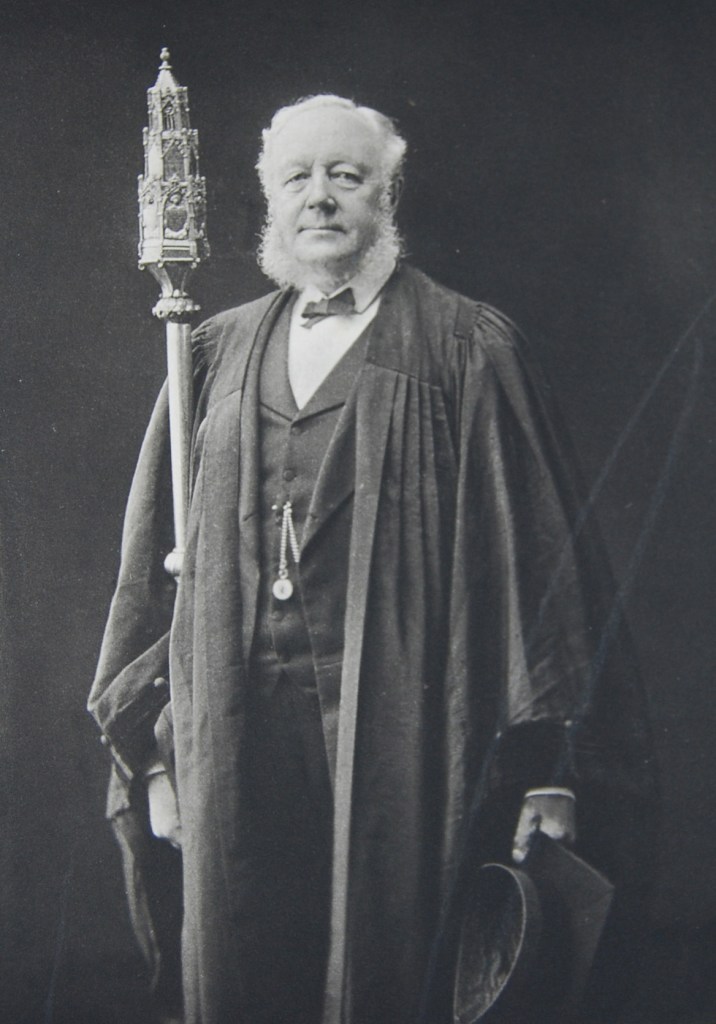
As one of the oldest University in Britain, Glasgow has got its own medieval Mace, which is almost as old as the University itself. Made in 1465 in France, it has a silver shaft and a hexagonal head of gold and enamel work. The Mace had to be beautiful and impressive: it represents the University, its internal authority over its members and its independence from external control. That’s why it is depicted on the coat of arms of Glasgow University and on its seals.
This precious ceremonial tool is richly decorated, especially the head, which bears six coats of arms representing the arms of Scotland and of Glasgow, and of figures who played an important role in the history and the development of the University: Bishop William Turnbull, James, first Lord Hamilton, and Sir James Douglas, 4th Earl of Morton. The last shield bears an inscription, which reads: ‘Haec virga empta fuit publicis Academiae Glasguensis sumptibus A.D. 1465, in Galliam ablata A.D. 1560, et Academiae restituta 1590’, that is to say: ‘This rod was bought at the expense of the University of Glasgow in 1465; it was brought to France in 1560, and returned to the Academy in 1590’.
6 University of Bristol
Bristol’s Mace was provided by a generous donor:

This intricately designed silver mace, bearing the University coat of arms, is used on formal occasions such as graduation ceremonies. The mace was given to the University by Sir Stanley Hugh Badock who was a generous supporter of the University. Badock was Chairman of Capper-Pass, the metal refiners and manufacturers, from 1905-1936. He was Sheriff of Bristol for a term, as well as holding the roles of Chairman, Treasurer and Pro-Chancellor of the University’s Council at various times.
5 Oxford Brookes University
Oxford Brookes has a very recently designed mace:
The University wished to encourage real student engagement with the concept, design, and production of the mace; and a student competition to design the Oxford Brookes mace was therefore launched, in October 2016. Students and recent alumni were invited to submit a concept and an initial design, to an outline specification.

In January 2017, Fattorini Ltd – silversmiths and mace manufacturers by royal appointment – worked up the shortlisted designs to show how the final artefacts would appear; and we invited the University community – students and staff – to vote for their favourite design. Rhys Herbst, who graduated in June 2016 from the Foundation Art and Design course, designed the mace as part of a student design competition and carried the artefact at the first of the September graduation ceremonies.
4 University of London
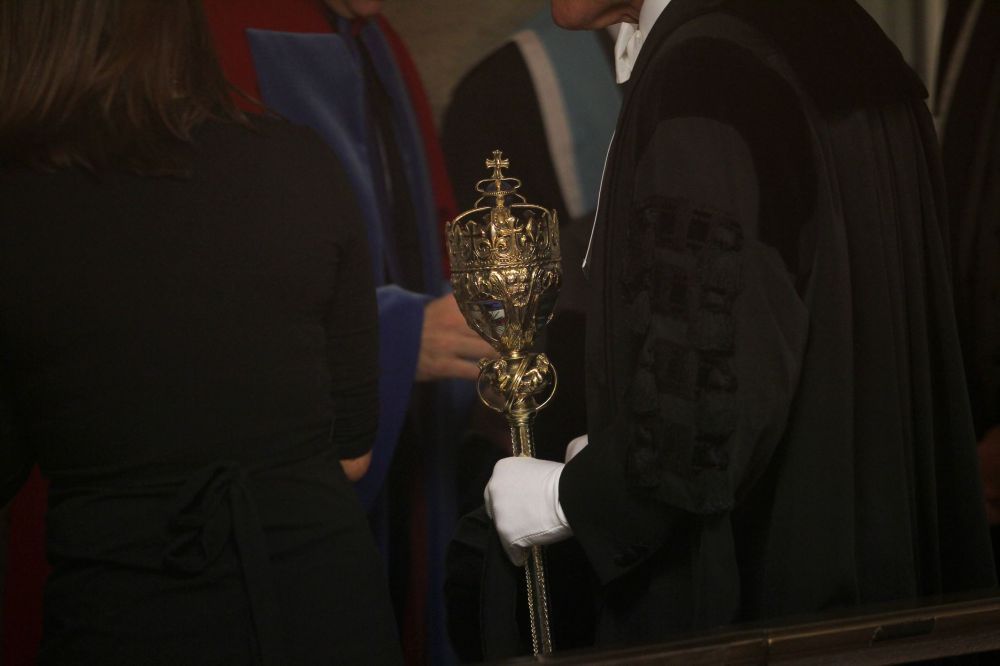
The Chancellor’s Mace was made in 1901 by goldsmiths and silversmiths Ramsden and Carr of London and presented to the University by Sir Henry Roscoe, Vice-Chancellor from 1896 to 1902. The original design was subsequently bequeathed to the University.
3 Open University
The OU has a thoroughly modern mace:
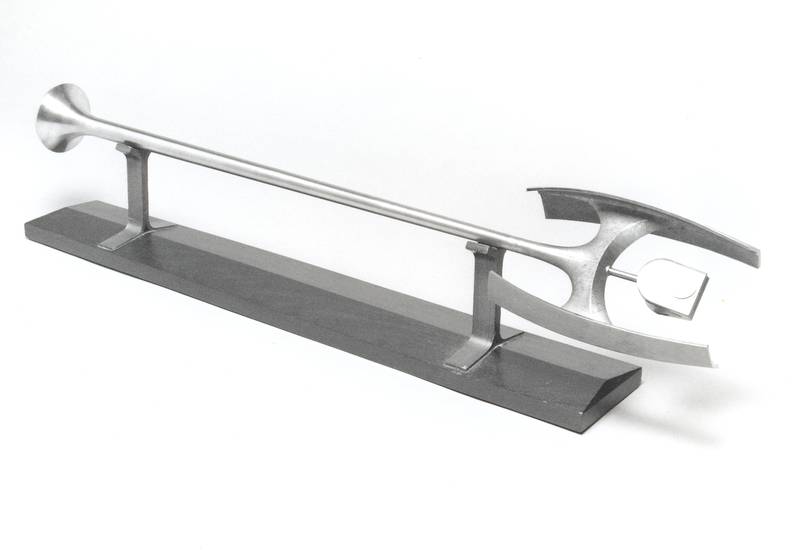
The Open University Mace is an example of the early use of titanium for decorative purposes in an area where precious metals were normally used and had been for hundreds of years. The decision to use titanium was taken in 1970 when Eric Clements, then Head of the School of Industrial Design at Birmingham College of Art, was commissioned by Imperial Metal Industries (IMI) to design a mace to be presented to the Open University.
2 University of Cambridge
Cambridge has several maces. Don’t lose your head though:
Maces are recorded as in use by the University as early as 1276, but the three silver maces currently carried (two at a time) by the Esquire Bedells in University processions are much newer. They were presented to the University by George Villiers, Duke of Buckingham, Chancellor from 1626 until his assassination in 1628. A fourth mace, with a mahogany shaft and silver ends and rings, was carried by the Yeoman Bedell, and was almost certainly presented to the University by Villiers’ successor as Chancellor, Henry Rich, Earl of Holland (beheaded 1649), whose arms it bears.
1 St Andrews University
Top of the heap, St Andrews has a fine collection – it undoubtedly scores higher for multiple maces but any one of these would probably be top 10 on its own:
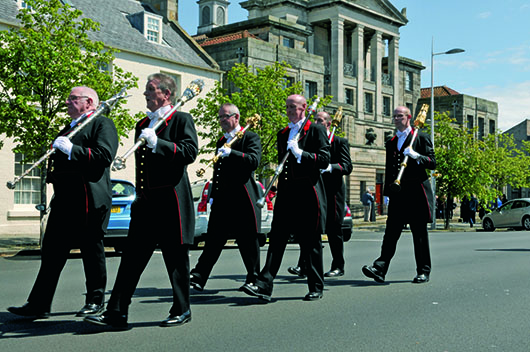
The University has in its collection six maces, three medieval and three from the 20th and 21st centuries. The three medieval maces, the Mace of the Faculty of Arts (completed 1418-19), the Mace of the Faculty of Canon Law (mid-15th century) and the Mace of St Salvator’s College (1461) are of outstanding workmanship. The modern maces are: the Mace of the School of Medicine (1949, designed by C. d’O Pilkington Jackson), the University Mace (1958, designed by Leslie Durbin) and the Rector’s Mace (2002, designed by Donald Wintersgill).
Here it is then, your full UK University Mace Top 10:
1 St Andrews University
2 University of Cambridge
3 Open University
4 University of London
5 Oxford Brookes University
6 University of Bristol
7 University of Glasgow
8 University of the Highlands and Islands
9 Dundee University
10 University of Liverpool
So, there you have it, the inaugural university mace league table. It is possible that St Andrews may have had something of an advantage on account of its mass provision of maces. My own University narrowly missed the cut too, which is going to cause an issue or two.
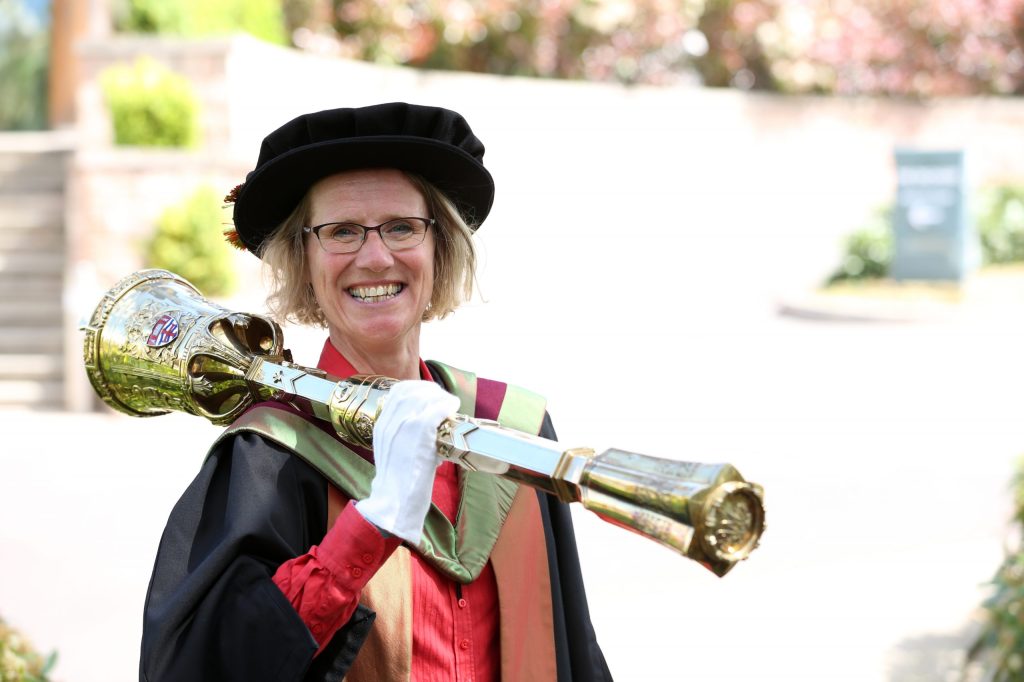
And let’s not forget the essential role of the Esquire Bedell, a vital component of every degree ceremony – those maces don’t carry themselves you know. Nottingham’s very own Dr Gaby Neher, pictured with mace at the top of the page, became the University’s first female Esquire Bedell back in 2022.
Are there other maces which should have made the top 10? Who will triumph in the next league table? Until it’s time to do it all again…

 The Wonderful (& Frightening) World of HE
Leave a comment