
Lifelong learning. And then some.
Whilst I have been at great pains to point out that I’m not quite ready to retire just yet I have nevertheless been intrigued by those options, mainly in the USA, on offer for those who want an ongoing university connection for their retirement experience. I have covered this kind of thing before, despite apparently not being interested in retirement, and noted that in some cases these are simply private retirement homes which happen to be located adjacent to a campus and have no meaningful connection to the university. But in other examples institutions have actually established retirement communities for alumni which involve close engagement, support and access to university services and facilities as well as learning opportunities. The advertising blurb makes many of these look pretty impressive too. A bit like an extended Saga cruise with all the positives (if you like that kind of thing of course) without ever having to get on a ship.
Serious business
According to University Retirement Communities (your #1 source for information on this kind of thing, apparently) this all started at Iowa State and Indiana Universities in the mid-1980s with big expansion happening over the past 20 years or so. They estimate that there are up to 100 retirement communities in the US with some kind of academic institutional association.
Naturally there is an expectation of continued growth with “approximately 10,000 Baby Boomers turning 65 each day” – this is apparently the most highly educated demographic in history and therefore much more likely to want an ongoing connection with education. There is also it appears some research to suggest people living in this kind of ‘Life Plan Community’ report better “emotional, social, physical, intellectual, and vocational wellness than older adults who remained at home.”
This being higher education it is perhaps unsurprising that there is an accreditation route available for university-based retirement living. These are the criteria for certification as a University Based Retirement Community:

- Proximity to the host academic institution
- A continuum of services, including up to Independent Living, Assisted Living, Memory Care, and Skilled Nursing care
- Formalized programming between the community and the academic institution
- A formal relationship between the community and the academic institution
- A resident population that includes a least a 10% mix of academic institution alums, retired faculty or staff
It’s a serious business.
The A-list
This list from another information provider – it lists over 80 such communities – gives an indication of the range of institutions involved and some of the reasons for the popularity of the approach:
College-linked retirement communities offer a return to a stimulating environment they enjoyed decades earlier. Residents audit classes and may even teach. They may also attend various cultural and sporting events on campus.
The motivation for seniors returning to campus is qualitatively different from those who choose traditional retirement communities. They hunger for something more than warm weather and a condo on the fifth green. It is fundamentally about personal growth, stimulation, the development of a more meaningful life, and a supportive intellectual and cultural climate to make it happen. They want to continue to learn and enrich themselves.
Last time I wrote about this kind of development, I highlighted Arizona State University’s community facility called Mirabella at ASU. Mirabella offers a wide variety of benefits to its residents:
Mirabella at ASU is a truly unique retirement experience—an intergenerational community fueled by lifelong learning and collegiate energy. On the campus of Arizona State University—one of the most dynamic and innovative research facilities in the nation—Mirabella at ASU puts you in the heart of an urban oasis bursting with culture, life, learning, and excitement. You’ll live just a short walk away from the historic ASU Gammage theater, countless lifelong-learning opportunities, and a wealth of dining and recreational opportunities in downtown Tempe.

I have to say this really sounds like a hugely impressive development and you can see how the association with the university is a real selling point. And all of this does perhaps begin to look increasingly attractive to former university staff like me who are getting on a bit.
Back in 2002 the University of Central Arkansas established its College Square retirement community which claims to have a distinctive selling point:
College Square is prominently featured on the corner of the University of Central Arkansas. We’re the only retirement community physically on a state college campus in the USA! We’re trailblazers! With College Square’s location on campus, you will receive special UCA privileges and have endless opportunities for personal growth and experiences. You can audit a class, attend sporting events or enjoy the latest production in Reynolds Performance Hall.
It certainly looks like there is plenty of higher ed adjacent activity to experience at College Square.
Meanwhile the University of North Carolina at Chapel Hill has its own retirement campus called the Cedars of Chapel Hill:
One look and you can tell that The Cedars of Chapel Hill is a very special place that attracts very special people. As a Life Plan Community, we are committed to meeting the needs of those very special people — seniors seeking new possibilities and planning active, healthy lives. All within a beautiful, 50-acre campus that honors your accomplishments, reflects your aspirations, inspires independence, and acknowledges that life has been good to you. And now it gets even better.
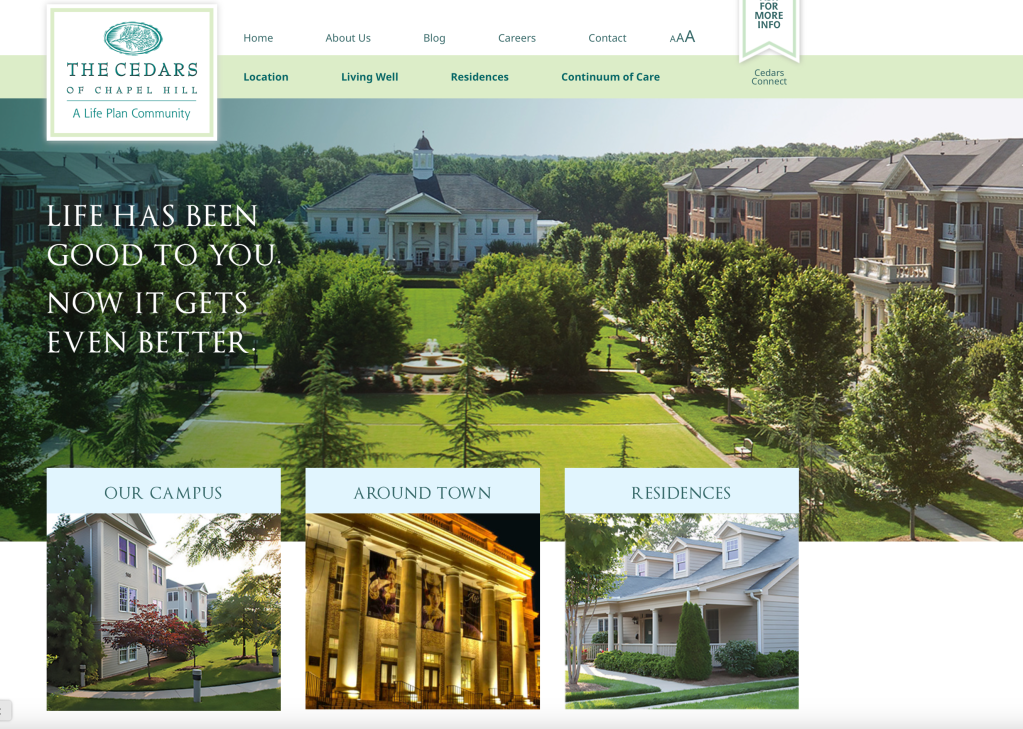
Classy.
Beyond the US
In South Korea, the Korea JoongAng Daily reported on the development plans at a pair of universities looking to the retirement home market to offset a forecast decline in student numbers:
Tongmyong University and Chosun University signed a memorandum of understanding to create a retirement community on their campuses in March.
A retirement community will be built near the main gate of Tongmyong University in Nam District, Busan, with around 600 residences. Chosun University’s community will have around 700 residences and will be built near the Chosun University Hospital in Dong District, Gwangju.
Older people will pay to stay at the on-campus retirement communities, while the university will offer various classes and health care support. There will also be programs for older people and university students to come together.
The universities plan to tap into the retirement home business while the student population declines.
The article also reports that the Catholic University of Pusan is another university planning to create facilities for older people, working with the Busan Metropolitan Government to create the “HAHA” campus, short for “happy aging healthy aging.” So there is a strong financial motivation for pursuing such a development. In South Korea at least. But all of these developments have yet to get off the ground. And there aren’t many other examples around outside the US.
Opportunity knocks?
Given the aging population world wide and the increasingly educated age groups in a large number of nations it does seem that there is real potential for this kind of development beyond the US. The model is there and it could work elsewhere. Whilst there has not been a close association between retirement communities and universities in the UK and they do not appear to share many business characteristics at all, with a bit of creativity and imagination there is surely an opportunity here.
Not only do universities need to embrace the demographic shift to a more aging society and find more ways to cater for genuine lifelong learning they have to find new income streams. This kind of development offers the opportunity not only to improve estate utilisation and a new source of revenue but to create a much broader and age-diverse campus community. And beyond this a university retirement community could be seen as a living lab which would enable institutions to explore how best to address the needs of older learners
Will be interesting to see then if any UK universities do go down this route. And whether universities in other countries adopt the model too.
 The Wonderful (& Frightening) World of HE
Leave a comment