
Following the magisterial survey some years ago by David Kernohan of higher education reviews and legislation it seems appropriate to return to this most important of issues and yet again take a different angle on this information, one which avoids serious consideration in favour of controversy and distraction from the real issues.
You might have thought that the Professor Boaty McBoatface ranking was pretty pointless or that this league table of University Motorway Service Stations lacked a modicum of statistical validity. These efforts though are barely worthy to clean the boots of this latest offering.
We have therefore returned again to the full list of UK Higher Ed Reviews and Legislation which has, perhaps surprisingly, seen some movement over the last couple of years.
Ranked by a combined score derived from a judgement of ultimate impact and the outcomes of a comprehensive survey of former registrars based in the central Nottingham area and then weighted, this latest league table remains impossible to argue with and yet quite difficult to defend.
So, without further ado, here’s the top 10 ranking of HE legislation and reviews.
The top ten
There has only been modest movement in the top 10, as you would perhaps expect given the serious and weighty nature of these matters. But there has been change – remarkable in itself given the content.
10. 1994 Education Act – slipping one place to number 10, this little-loved piece of legislation had a significant effect on teacher training, with the creation of the Teacher Training Agency, but also sought to bring change to what was perceived by the then Conservative government as the “closed shop” of students’ unions by enabling individuals to opt out of membership. A massively inconsequential measure as it turned out.

9. The Browne Review 2010 – sliding down the top 10, Lord Browne and his report certainly caused a stir back in 2010, recommending uncapped undergraduate fees (rejected by the government and a £9,000 cap imposed) and various other student finance initiatives. Essentially though the report resulted in today’s student finance model which, whilst generally out of favour with most, is still there so that does tell us something about the impact of this review.
8. A re-entry into the top 10 at 8 is the Anderson Report of 1960 which recommended the introduction of mandatory grants for living costs and tuition fees for full-time UK undergraduate students.
7. The Jarratt Report 1985 – a further drop down the charts for the Jarrett report as its recommendations now look rather mild whereas at the time they looked pretty dramatic. The review was concerned with “whether management structures and systems were effective in ensuring that decisions are fully informed, that optimum value is obtained from the use of resources, that policy objectives are clear, and that accountabilities are clear and monitored.” It had a real impact on universities at the time (you can read more here), particularly in changing their committee and management structures and the effect of some of the recommendations can still be felt, albeit faintly. Some people are still cross about it though so it is still in the top 10.
6. 2004 Higher Education Act – dropping slowly down the chart despite its continued niche popularity this Act introduced variable fees for the first time as well as creating the AHRC and the post of director for fair access.
5. 1992 Further and Higher Education Act – dropping just one place from number 4 this Act has classic appeal with its pathbreaking approach – allowing polytechnics to become universities, creating the funding councils and, joy of joys, establishing a new quality assessment regime. No wonder it was once tipped for the top.
4. 1986 Education (No 2) Act – up two places into the top 5 for the first time in over three decades this delightful act is still making waves with its requirement that universities “take such steps as are reasonably practicable to ensure that freedom of speech within the law is secured for members, students and employees of the establishment and for visiting speakers”. More recent legislation has sought to supplant this Act but has yet to make this kind of impact, instead leading to its improved ranking.
3. 1988 Education Reform Act – still holding on at 3 this Act was primarily focused on compulsory education but it also had a real impact on HE including controls on use of the term degree, ending academic tenure and, even more significantly, taking polytechnics out of local authority control.
2. The Dearing Report – a classic from 1997 which is still pressing for the top spot. As Kernohan puts it, Dearing:
was seen as a Haldane or Robbins for the late nineties in setting out a new generational settlement. His committee was backed by both parties, but the Blair administration used his substantial contribution to the debate primarily to introduce “top-up fees” – responding to a continued sector concern around the unit of resource increasingly backed by indications that some universities would unilaterally impose their own tuition fees.
It was a thumpingly big report with 93 chunky recommendations covering almost every aspect of HE. David Watson, assessing its impact a decade on argued that over a quarter of these recommendations actually made a difference and a further quarter happened quite slowly. Will it make it to number 1 next time around?
1. The Robbins Report (1963)
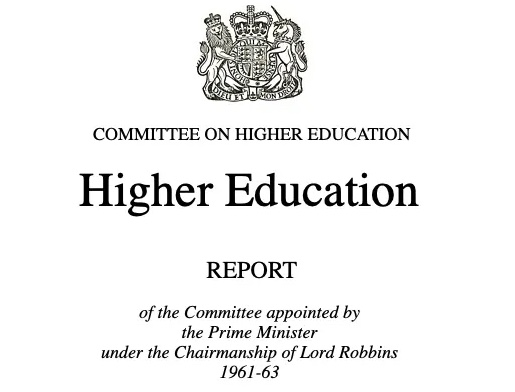
Still at number one after over 60 years, this benchmark report had a profound and long lasting impact in its recommendations for expansion of universities, upgrading of CATS and student number growth as well as concluding that university places “should be available to all who were qualified for them by ability and attainment”. And it recommended the creation of the CNAA. While Robbins undoubtedly generates significant report nostalgia among HE wonks, it remains firmly rooted in the number one spot.
Dropping out of the top 10 since last time is the 2017 Higher Education and Research Act – it was very much the new kid on the block but already has fallen out of favour with just about everyone as a result of its burdensome regulatory impact and stimulus for shiny new ‘challenger’ universities and all that kind of thing.
So there’s your all new top 10 in full:
| Rank | Name | Year of publication |
|---|---|---|
| 1 | The Robbins Report | 1963 |
| 2 | The Dearing Report | 1997 |
| 3 | Education Reform Act | 1988 |
| 4 | Education (No 2) Act | 1986 |
| 5 | Further and Higher Education Act | 1992 |
| 6 | Higher Education Act | 2004 |
| 7 | The Jarratt Report | 1985 |
| 8 | The Anderson Report | 1960 |
| 9 | The Browne Report | 2010 |
| 10 | Education Act | 1994 |
There is, sadly, no place in the top 10 for these nevertheless impressive reports and reviews:
- The Independent review of higher education pay and conditions – The Bett Report from 1999;
- The Report of the Royal Commission on Scientific Instruction and the Advancement of Science – The Devonshire Report from 1872-75;
- And who can forget the Report of the Machinery of Government Committee – The Haldane Report from 1918 (which brought the University Grants Commission into being).
And whilst there will be a few arguing for the inclusion of the 2023 Higher Education (Freedom of Speech) Act, that’s just not anywhere near the top 10 right now so you can cancel me for that whenever you fancy.
There will also be those holding a torch for the Leitch Skills Review of 2006 or the Oakes Report of 1978 into the Management of Higher Education in the Maintained Sector or even the Report of the Departmental Committee on Intermediate and Higher Education in Wales, also known as the Aberdare Report (that was back in 1881 in case you were wondering). This before we get to the Barlow Report of 1946 or any of the seemingly rather frequent Royal Commissions on the Universities of Oxford and Cambridge. Again, unfortunately, all of these review committees just need to try a bit harder.
Until next time…

 The Wonderful (& Frightening) World of HE
Leave a comment