
One of the five priorities for the sector set out by the Secretary of State in her November 2024 letter to Vice-Chancellors concerned efficiency and reform:
5 Underpinning all of this needs to sit a sustained efficiency and reform programme. I know many higher education institutions are already making difficult decisions to ensure they are financially sustainable – and I welcome the efforts that the sector is already making, through Universities UK, to identify opportunities for system-level change. However, adapting to the changed context of the higher education sector over the next decade will require a more fundamental re-examination of business models and much less wasteful spending. We will need to see far greater collaboration across the sector to drive efficiency.
There is a lot in here which is also clearly pointing to the need for system change as well as reform at institutional level together with the need for more collaboration “to drive efficiency.”
And as I have observed on a number of occasions here before (see for example this article)a great place to start with all of this would be in improving the efficiency of and reforming the regulatory regime. But there is plenty more to look at too.
David Kernohan, writing on Wonkhe in 2024, noted many of the challenges associated with looking for greater efficiencies in the sector and the recent history of efficiency reviews including the 2011 launch of the Universities UK Efficiency and Modernisation Task Group led by Ian Diamond and the Efficiency Exchange operation established by sector agencies in 2013 which offered a wide range of case studies and examples of good practice for efficiency enthusiasts in universities and colleges to draw upon.
Kernohan’s piece also refers to the powerful examples, often deployed by sector leaders (I have done so myself), of where institutions have collaborated to deliver efficient operations which save everyone money and effort. These include: the JANET academic network and other IT services provided by Jisc; UCAS, the undergraduate applications clearing house which was established by the sector for efficiency reasons but is now an independent charity with a large commercial operation (designed to subsidise its operations and reduce costs to applicants and institutions) but which does feel increasingly remote from its origins; and the UK University Purchasing Consortia (UKUPC), a collection of sector purchasing groups which have established buying frameworks for almost all the items an institution may wish to procure.
Sadly, this proposal for a single student record system for the sector, has yet to come to fruition.
Efficiency, efficiency, efficiency
Efficiency matters, sure. But without considering also effectiveness and the quality of service or experience then you are left with something that is lacking – a one dimensional offer which delivers for some but not for most. And efficiency is often unhelpfully and erroneously deployed as a synonym for cheaper. This confuses things further. But let’s look at a couple of theoretical examples of the issue here.
Take example of a budget airline. It can be extremely efficient in terms of its service, always ensuring that planes take off and land on time and minimizing the cost (to itself) of all those pesky extras by either removing them completely (no-one really needs a fabric headrest or a seat pocket in front of them) or making passengers pay extra (you mean you wanted to bring luggage on your international flight?). But it can also offer a very poor quality experience for its customers because of all of those nice things it has eliminated. And it can sometimes be quite ineffective, delivering passengers to an airport many miles from the actual destination they were expecting.
Similarly with trains – a train operator could have extremely punctual services, highly efficient you would say, but if there are never enough carriages to take all of the passengers on the platform that makes an extremely ineffective service and for those who do make it on board if the train is poorly maintained and with standing room only then it really is a poor quality experience.
Legendary management guru Peter Drucker is often quoted as saying “Efficiency is doing things right. Effectiveness is doing the right thing.” He was saying this, well over half a century ago, in the context of a raft of other advice encouraging executive leaders to take a different approach to running their companies. But the principles are worth retaining.
Cultish behaviours
All this has reminded me of a fascinating book recommended to me by my former PhD supervisor, Professor Nigel Norris. Over 60 years since its publication it remains a fascinating read and sits midpoint between two eras of educational change which, perhaps surprisingly, seem to have a lot in common.
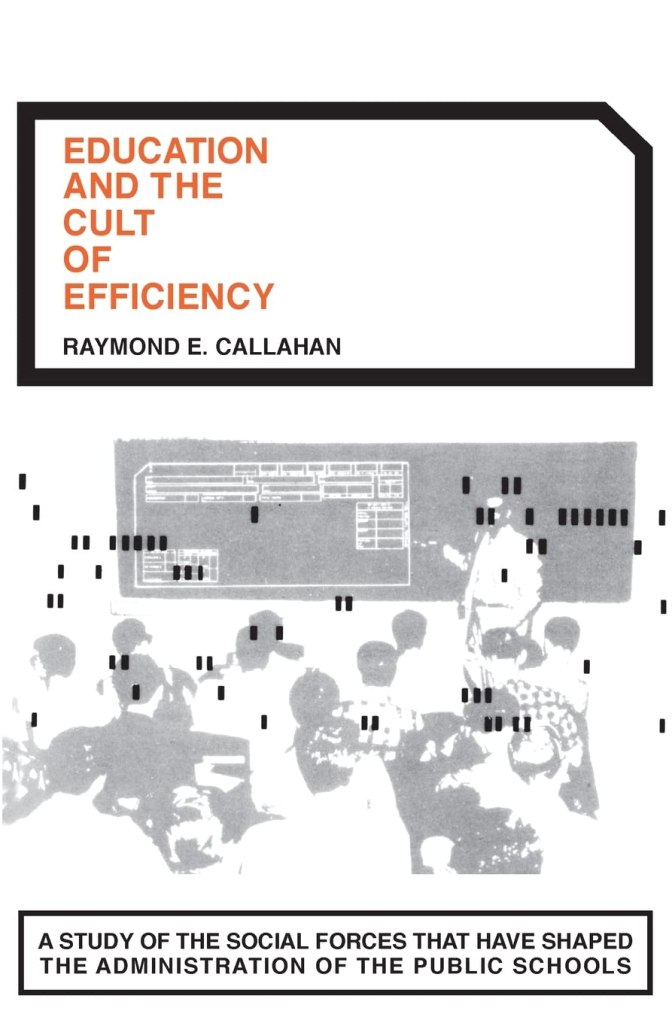
Raymond Callahan’s book, Education and the Cult of Efficiency, published in 1962, offers a salutary warning about the hazards of imposing inappropriate models in education. When I first looked at this I was interested in the ways in which industrial quality assurance frameworks seemed to be enthusiastically adopted by some in higher education with little regard for context, with one of the main drivers for the application of industrial models to HE being the belief that efficiency and economy will result.
The economic imperative is one which has been apparent in higher education with ever greater force since the early 1970s but has forerunners in other spheres too. Callahan’s detailed and in many ways prescient study, shows the effect of scientific management, Taylorism, on US schools in the early part of the last century, the effects of which were felt in the American education system until the 1960s.[i] The essence of the problems this approach caused are articulated by Callahan as the promotion of cost accounting over educational value and these ideas permeated the whole education system including the universities.
The notion developed of schools as ‘service stations’ which represented the ‘natural outgrowth of years of business influence’ and the idea ‘that the public should provide the specifications for the educational ‘products’ which were turned out by the schools’.[ii] These concepts provide interesting parallels with the educational landscape in the UK today where there are sweeping statements regularly made about there being too many graduates, courses offering poor value for money and indeed programmes which should not be provided at all (so-called “Mickey Mouse” courses).
The primacy of the world of business was as real in the US of the second decade of the last century as it is in the UK today with ‘the community’ and ‘the business community’ being seen by many school administrators at that time as synonymous. Students were expected to undertake service for their communities (which often meant cheap labour for local employers) and there was a strong emphasis on the importance of student thrift. The response by school administrators, in the face of a critical public which was concerned with economy in public spending, was to seek to turn educators into technicians producing products to specifications.
The tragedy of scientific management in education
US school administrators therefore embraced economy measures and accepted increased class sizes based on ‘evidence’ that large classes did not diminish performance, a situation which remained in US schools until the 60s. One of the side-effects of this economy drive was a disproportionate focus on the trivial and measurable, a development supported by the training given to school administrators in graduate schools of education. This resulted in work which focused on measuring, for example, toilet paper use, ink consumption and heating savings.[iii] As late as 1938 a text on the principles of school administration included specific instructions on how a janitor should dust desks. Callahan also cites Flexner who shows that the emphasis on service, selling education, mass production and measurement of trivia was equally widespread in US higher education at this time.[iv]
Overall, Callahan characterises the impact of scientific management as tragic with education ‘adopting values and practices indiscriminately and applying them with little or no consideration of educational values or purposes’. The wholesale adoption of basic business values and techniques represented a serious mistake in education and in the period from 1910-1929, when efficiency was demanded, what was actually meant was lower costs with no reference to the quality of the ‘product’. At this time the public was suspicious of public institutions and in awe of the world of business (before the stock market crash) and saw scientific management as an appropriate solution. Administrators were, in this context, entirely complicit with this misapplication of business processes and values. The impact of this period was widespread and enduring (despite the depression), as those trained during this period went on to hold positions of power for many years, and the ideas remained dominant into the 1960s with an emphasis on business and technical values at the expense of the educational. Similar societal factors can be seen in the UK in the 1980s onwards which perhaps helps to explain the longevity of industrial ideas in education in this country too.
It couldn’t happen now?
It is easy to discount the crude simplifications of scientific management and to mock the absurdities of these pointless measurements deployed many years ago in place of any meaningful assessment of quality and value. But there remains a real risk that in order “to drive efficiency”, as the Secretary of State wishes, unwise decisions will be made, by institutions and at sector level. Whilst there are good examples of cross-institutional collaboration and sector-level shared services, these remain limited to date for many reasons (including some knotty issues around VAT). The funding challenges faced by many institutions and the likely absence of any rescue packages being offered by government mean that extreme measures may be taken with crude views about what is believed to be most efficient trumping more rational approaches.
Whilst I think it is highly unlikely a cult of efficiency similar to that described by Callahan will take hold in UK higher education, the risk of the possible dominance of the efficiency narrative over matters of effectiveness and quality remains real. It is to be hoped that in driving efficiency, the other fundamentals are not forgotten.
Note
The above draws on a piece I wrote for Wonkhe over a decade ago and also some material featured in my book from even longer ago: Dangerous Medicine: Problems with quality and standards in UK higher education (which is still available via Amazon at what I’m sure we’d all agree is a very competitive price).
[i] Callahan, R E (1962), Education and the Cult of Efficiency, Chicago: University of Chicago Press.
[ii] ibid, p227.
[iii] ibid, pp242-3.
[iv] ibid, p243, referring to Flexner, A (1930), Universities America, English, German, New York.
 The Wonderful (& Frightening) World of HE
Leave a comment