
Stories about bad things happening in higher education are always attractive to the media. The Sunday Times in particular seems to dedicate significant effort in rooting these out and then making a very big deal about them – they do like finding ways to have a go at universities. This was their big splash on 23 March
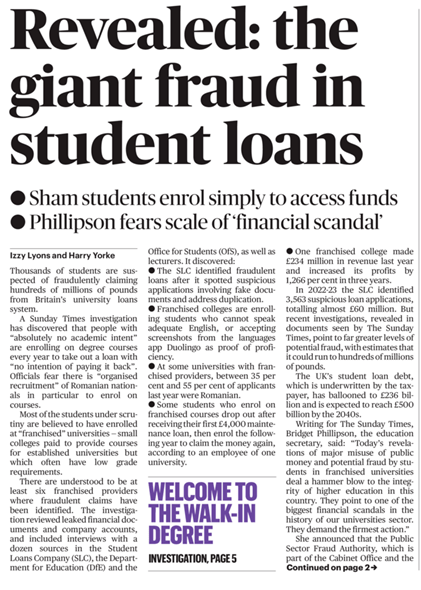
As a result of this the Education Secretary has ordered an investigation by the Public Sector Fraud Authority (which I must admit is a new one for me) into the fraudulent activity which is enabling the wrongful claiming of student maintenance and loans by many individuals who have no intention of studying.
There are two big elements to this story. The first is the fraud component and this has to be chased down and stopped. It is, unfortunately, the case that education looks like a soft target for fraudsters – for example the Individual Learning Account scheme from 25 or so years ago where over a third of the money allocated was estimated to have been subject to fraudulent and improper claims. It is absolutely right therefore that the Government address this as a matter of urgency.
You could argue that the fraud part of all of this is in some ways distinct and the rules for accessing student financial support should simply not enable this. It’s not the fault of HEIs if individuals who look to defraud the funding system by pretending to be students happen to be using their courses to do so. But the sector cannot get off the hook here. Both the nature and growth of the particular franchising arrangements described in the Sunday Times report facilitate this fraudulent activity.
Birds of a Feather?
So the fraud would not be happening, or at least not at such a dramatic scale, were it not for the growth in franchising activity. Addressing this will require action by the sector and by regulators. We have been here before. This excellent commentary from Jim Dickinson on Wonkhe covers the history of all of this and he notes that there has been a series of reports and investigations into different aspects of this matter over a number of years.
According to the Office for Students (OfS), in its recent report on sub-contractual arrangements, the numbers involved have really grown:
Since 2020, we have seen the number of students taught in these arrangements double, to over 138,000 in 2022-23 – over 5 per cent of students in the sector. 62 per cent of students taught under subcontracted arrangements in 2022-23 were studying business and management courses.
The report also says that 110 institutions are involved in sub-contracting of some kind.
The inspiration for much of this growth comes from the Higher Education and Research Act of 2017 (HERA), which sought to promote greater competition in the sector and usher in lots of exciting and thrusting new challenger institutions to shake up the old order. However, the practice of franchising provision long predates even that legislation.
Lord Willetts, a former universities Minister and HERA fan, on the Today programme today (24 March 2025) suggested that if only the OfS Register were open (the OfS had suspended applications from new entrants for a period to allow it to focus on all the other issues in the sector) then all of these institutions not already on the register would be queuing up with their applications so there would not be a problem. The OfS estimates there are around 250 institutions currently delivering franchised higher education which are not on the register. It does not say how many are petitioning for registration at present but my guess is not many – why would you?
The Secretary of State for Education, writing in the same edition of the Sunday Times in response to the investigation, stated that she had:
written to the current and incoming heads of the Office for Students, Sir David Behan and Edward Peck, to reiterate that this issue is a major priority for the regulator; to urgently set out stronger requirements of universities that franchise courses to other organisations ahead of the tough regulation we have announced coming into force. I have also asked the Student Loans Company to further step up its investigative work.
Finally, I will also bring forward new legislation at the first available opportunity to ensure the Office for Students has tough new powers to intervene quickly and robustly to protect public money, in addition to the stronger remit I have given it to monitor university finances.
Legislation may be required to tighten up loopholes in student funding arrangements but it is not clear to me that there are any barriers to the OfS acting in a rapid and robust fashion to address these issues right now. It is about priorities and responding to the areas of greatest risk.
Follow the money
This major growth in franchising is suggested by some (including Lord Willetts and Universities UK) to be benefiting those HE ‘cold spots’ in the UK, meaning that colleges can offer higher education in hard-to-reach places where people can’t really travel far to access it. There is also a suggestion that some of this activity is absolutely top notch, genuinely innovative and really breaking new ground, exactly as anticipated by HERA.
But as Mike Ratcliffe has noted in some detail through examining the financial statements of some of these franchisees, they do seem to making rather hefty profits. And as to those doing the franchising, there is a handful of universities really doing this at scale, who will be bringing in much needed income from the activity.

I had a period earlier in my career developing validation and franchising arrangements between a university and regional FE colleges – this was in the early 1990s though, pre-expansion and where the university involved was very focused indeed on the quality of the provision and the standard of achievement leading to awards in its name. The core aims of this were about access and reaching under-served communities in region full of cold spots. The university was keen to cover its real costs but this was absolutely not about making money, for any of the parties involved.
But not long after this there was a scandal in the sector involving validation and franchising overseas. The poor behaviour of a few institutions led to something of a panic and some additional regulatory intervention which affected everyone. Let’s go back in time…
Franchising all over again
Franchising and validation (which is distinguished by the student being registered at the delivery partner rather than by the lead institution) was a focus for concern about academic standards in the mid-1990s when another Secretary of State for Education, John Patten, speaking at the HEFCE 1994 April conference ‘invited’ the higher education sector to address the issue of standards and in particular ‘broad comparability of standards’. This followed negative comments made to Patten during a visit to South East Asia concerning the standard of UK degrees being offered there via validation and franchise arrangements. The then Higher Education Quality Council (HEQC) was asked by the CVCP (the predecessor of UUK) to address the matter and HEQC immediately determined to seek to address standards more within its Quality Audit process.
Patten’s comments were significant in that they opened up a major debate on standards in higher education which continued, in one form or another, for the remainder of the 1990s and beyond. His concern about the damage caused to UK higher education by some institutions’ somewhat cavalier validation and franchising activities overseas was shared by many in the sector too. HEQC Audit and newspaper reports indicated that UK institutions had been involved in dubious practices overseas, for example the reports on Swansea Institute and Southampton Institute in the 1990s. A number of other institutions faced criticism from the Quality Assurance Agency (QAA) in the early 2000s for aspects of their international arrangements too including Wolverhampton, the Open University, Derby and Thames Valley.
The starting point of Patten’s 1994 speech was the concerns which had been expressed to him about UK universities’ validated and franchised provision overseas. Such operations had been seen by some institutions as an income generating activity, valuable at a time of financial constraints. The practice became widespread within the UK too, particularly during a period of expansion where universities, pressed for space, reached agreements with (usually) FE colleges to franchise the early years (sometimes, but not always, including an additional, foundation year) of programmes to permit expansion of student numbers without increasing numbers on campus. As with my own experience, the motivation for institutions in such cases was not solely (if at all) financial gain. Rather it presented an opportunity both for growth and the fulfilment of elements of universities’ missions relating to equality of opportunity as well as expanding institutional influence over local or regional colleges.
Whilst institutions usually have lengthy processes of approval for such validated and franchised courses, if doubts were being expressed about standards in universities how can there be confidence that standards are comparable at other institutions where the franchisor or validator has no direct control over delivery, does not appoint staff, and (usually) does not undertake assessment? It was possible to argue, as universities did then and still do, that the processes they have in place are sufficiently rigorous to guarantee standards on such programmes. Indeed, this argument was largely accepted by QAA (as it was by HEQC) in Quality Audit at that time. However, the further a franchisee is from the franchisor (or the validated institution from the validator), either in distance or in terms of organisational structure then the concern must be that the awarding body’s ability to assure standards of awards issued in its name is greatly reduced. HEQC and QAA Audits of universities’ overseas operations highlighted these problems. Where the motivation for some of these arrangements is financial then the primacy of the maintenance of standards may be undermined. Franchising and validation practices therefore risk seriously undermining the reputation of UK higher education generally with potentially negative effects on the recruitment by all institutions of international students as a result.
That was then and this is now
So much for the history, where do we go from here? Beyond the investigations around fraud there does need to be a much closer regulatory oversight from the OfS (in England). This activity, be it franchising or validation, is inherently more risky than directly delivered provision. It therefore requires enhanced attention. Given that many of the delivery partners do not fall within the purview of the regulator and are not likely to be seeking registration any time soon then the focus has to on those on the register. This means that the 110 institutions which are franchising and the estimated 118 delivery partners have to expect greater scrutiny, starting with the largest in both categories and working down the list. It is not clear that additional legislation is required – rather the Secretary of State should direct the OfS to prioritise this riskiest of activities and intervene strongly as required.
As Jim Dickinson noted and as the look back to the 1990s above shows, we have been here before. These things do go in cycles and everyone (almost) has forgotten about those previous events. But reputational damage takes an awful lot longer to dissipate than institutional or sectoral memory. And it affects all parts of UKHE both in the minds of the public and potential partners and student recruits from overseas. This really does matter. Franchising is an inherently risky activity and requires further oversight as the fraud arising from it has demonstrated. Where the primary motive, for good or for ill, is financial then this is unlikely to be in the interests of learners, institutions or the sector as a whole.
 The Wonderful (& Frightening) World of HE
Leave a comment