
Anxiety and exit avoidance
There is huge anxiety across UK higher education at present about the state of institutional finances, the impact this is having in terms of likely job losses and the risk of some universities going bust. There does not appear to be a lot of visible activity being undertaken to address this although I am sure there are many discussions and much exploration of options happening behind the scenes in the Department for Education, with the Office for Students and with Treasury. The lack of information on all of this though is fuelling anxiety further.
One of the assumptions underpinning the 2017 Higher Education and Research Act (HERA) was that there needed to be more competition in the sector and that the arrival of new universities went hand in hand with market exit. Although covering a period both before and after HERA, a 2021 report by Stephen Hunt and Vikki Boliver on market exit of private providers found that over the period 2014-2019 198 institutions exited the private higher education market, representing 27% of the total from 2014 or 35% of the total number of private providers sampled by the authors. Many of these were small institutions, which had not been around for very long and enrolled small numbers of students.
This is probably what the authors of HERA had in mind. What they did not anticipate though was the kind of sector-wide challenge like the one institutions are currently facing. A disorderly collapse of one or more public institutions would be hugely problematic, messy and expensive to manage and would have serious consequences for students, employees, alumni, stakeholders, the economy and the towns in which they are anchor institutions and indeed the sector as a whole. Action is required to head this off and the question is whether there is enough that can be done within the current legislative framework to enable this to happen quickly.
Trouble by the Tay

One institution where things are taking place very much in the public eye is the University of Dundee. The full details of the lead up to the current crisis at the University are yet to emerge but the elements that have been surfaced do not look positive. Significant savings measures, including substantial redundancies, are now underway and financial support from the Scottish Government (£22m from a total government emergency fund for HE totalling £25m) has been required.
There is a different regulatory regime in place in Scotland of course (not HERA) and the Government there has launched a taskforce to be led by Sir Alan Langlands, former Principal and Vice-Chancellor of the University of Dundee and previous Vice-Chancellor of the University of Leeds as well as former Chief Executive of HEFCE and the NHS in England. This Strategic Advisory Taskforce will comprise a team of experts from across academia, industry and local and national government and will have a brief “to advise on the future success of the University of Dundee and its impact across the city region.”
According to Research Professional the taskforce will include representatives from Abertay University, the University of St Andrews, Dundee city council, the Scottish Funding Council and the Scottish government. It also reports that “Shane O’Neill, interim principal and vice-chancellor at Dundee, said the institution would “engage fully” with the taskforce.”
Interestingly, in parallel with the work of the taskforce, the Scottish Funding Council has appointed BDO to carry out a separate investigation into what happened with the university’s finances and this work is to be overseen by Professor Pamela Gillies, former Vice-Chancellor at Glasgow Caledonian University. She has recently published an outline of her team’s planned investigatory activity leading up to publication of a report in June.
South of the border
In terms of what government in England can do financially, it is clear that under the terms of HERA (para 41), the OfS does have the power to make a grant or a loan to a university on whatever terms and conditions it deems appropriate.

Of course it would need to have funds allocated by the Department for Education to enable it to do so as at the moment it really does not appear to have the resources. Beyond this the Secretary of State does have powers to make financial interventions themselves under HERA paragraph 77 where they can issue financial support directions. But this is only in the case of “mismanagement” and, if enacted, would inevitably have a range of additional consequences for the institution and its leadership.
But where there are institutions facing significant financial distress, the assistance is going to have to go beyond just providing them with a bit of extra cash. Some form of comprehensive rescue regime is going to be needed to avoid the possibility of a disorderly institutional exit (as discussed here a while back).
Learning from the past
As mentioned in this other blog recently there is an interesting case study from almost four decades ago which nevertheless provides some really good pointers to an approach to take here.
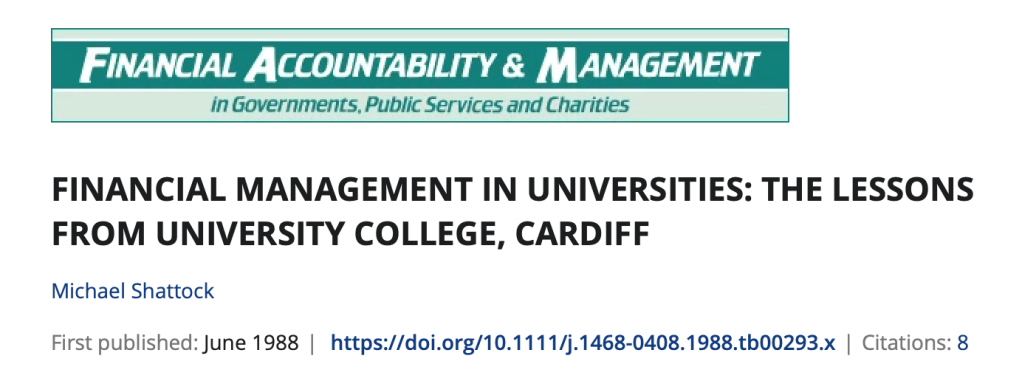
Back in 1987, in the period after the government cuts implemented from 1981 onwards, University College Cardiff (UCC) found itself facing insolvency. This necessitated some bold action by the Department for Education and Science (DES) to address the problems which, ultimately, resulted in a successful turnaround for the institution. Full details of the events relating to UCC can be found in this article by Mike Shattock from 1988 entitled Financial Management in Universities: The lessons from university college, Cardiff. I do want to draw out some of the key points from this fascinating piece here.
UCC was largest constituent college of University of Wales and had suffered a lower funding cut than many in 1981. But a significant factor in its positioning was a long-standing agreement to merge with a neighbouring institution, the University of Wales Institute of Science and Technology, UWIST. This merger had been long recommended by the University Grants Committee (the UGC) but had been frustrated by both institutions, in part due to hostility between the Principals, both of the governing bodies and many of the parallel departments. Also, according to Shattock, UCC “believed itself to be the senior institution both in history, status and academic performance.” These were not great foundations for an effective merger,
Over-optimistic international fee forecasts
Given the financial position the Permanent Secretary at the DES commissioned a report from Price Waterhouse into UCC’s finances. Among many of the aspects of this case with contemporary relevance the report noted that UCC had established a number of projects to grow its income and
had sought to cover its deficit by increasing its income from overseas student fees. Unfortunately its reliance on Nigeria, where the Principal and a number of colleagues had extensive contacts, proved misplaced because Nigeria’s exchange control regulations effectively negated Nigerian students’ tuition fee commitments.
The Price Waterhouse report confirmed the terrible state of UCC’s finances and was highly critical of the approach to financial planning and its over-optimistic assumptions.
As a result, the Permanent Secretary made it a condition of future grant funding that a team of external finance experts be appointed by UCC’s Council (after consultation with the UGC) to take control of the institution’s finances. In addition, another team of independent advisors was required to review financial management, information system and relevant professional services. This was set out in a letter from the Permanent Secretary to the UCC Council and, as Shattock observes, represented a significant development in the level of external intervention into the management of an autonomous institution. But the next steps he reports were particularly interesting I think:
The difficulty and potential cost of imposing a professional accounting firm possibly unfamiliar with university conventions was this time avoided by the clear encouragement to draw expertise from the rest of the university system. In the event the College sought the best of both worlds as on the UGC’s suggestion it approached a Registrar from another university who drew on his own finance staff for support and at the same time it commissioned a firm of accountants on its own account. In practice the two groups worked closely together as a joint visiting team.
Although circumstances are different in many respects, the model being followed at the University of Dundee is not that far removed from this approach.
Avoiding difficult decisions
The article sets out in some detail the poor financial and people management arrangements at UCC and the culture which meant that “difficult decisions were always avoided”
Part of the change introduced at UCC was a significantly revised organisational structure intended to prevent recurrence of anything like this situation. This included the following steps:
The visiting team recommended a strengthened, reorganised Finance Office, a unitary administration under a new Registrar, an up-dated and re-structured financial management information system, a review of the Financial Regulations with firm disciplinary action against those who offended against them, the establishment of an internal audit capability, a streamlining of committee business with an emphasis on university officers offering clear advice on the financial implications of committee decision-making and a command structure by which financial returns with head count data were presented monthly to the College authorities and the Finance Committee as an essential control mechanism for bringing the College back into credit.
But, as Shattock rightly observes, there was a need for a significant cultural shift in order to ensure these changes were sustained
UCC management was ‘top down’ and muddled, with no professional administrator and few senior academics in a position or willing to challenge financial decisions. There was little sign that this was going to change. The real lesson to be drawn from the Cardiff experience is that organisational culture is a crucial element in the management of an institution. Good financial management is dependent on a positive organisational culture and an ineffective organisational culture will not easily be changed quickly either by removing a few senior individuals, or by external exhortation through the medium of efficiency reports or governmental pressure. An effective organisational culture needs to be developed and maintained over many years: there are no short cuts.
There is plenty of rich detail in the piece about what went wrong and the wider consequences, including the establishment of the UFC in place of the UGC and the aim to introduce greater controls over universities to prevent future calamities of this kind. It really is a fascinating case study.
A ‘Transformation Scheme’ and other lifeboats
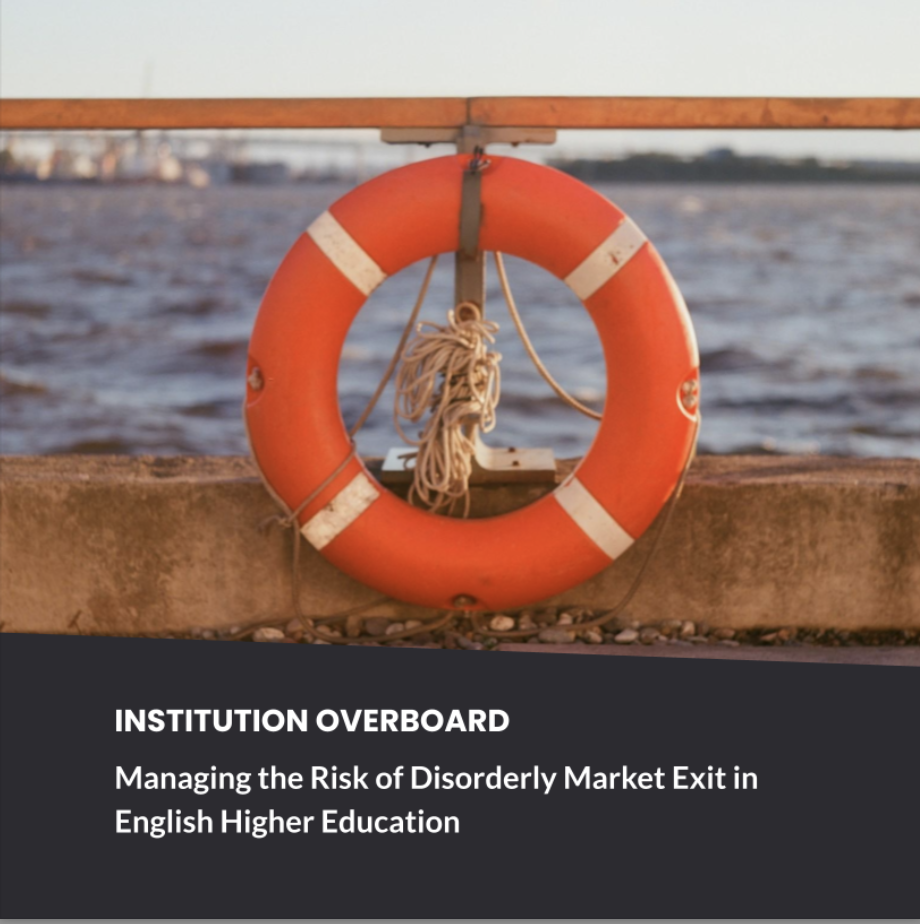
A 2024 report from Public First on addressing the risk of disorderly exit, as noted here before, makes a number of sensible recommendations for supporting institutions and avoiding university failures, including a funding pot and administration arrangements for those which are forced to exit:
the creation of the Higher Education Enhancement and Transformation Scheme (HEEATS) worth between £2bn and £2.5bn over the Parliament, to offer loans to institutions that can make a compelling case for restructuring their university such as to deliver a more sustainable and high quality provision – thus pre-empting either exit or forced closure of provision where that is not in response to student demand.
A creation of a new Special Administration Regime, modelled on that which exists in Further Education and other critical national sectors such as railways. This would allow for a more orderly form of exit should restructuring not be possible or effective, and would allow for protection for students and other national public assets under the law, in advance of a more orderly wind-down.
The proposal for a government-funded Transformation Scheme which would provide loans to help institutions get themselves into better shape, modelled on the Higher Education Restructuring Regime which was introduced during Covid but taken up by very few, makes sense. There would, inevitably, be many strings attached and close monitoring required but it has to be a better choice for a governing body than insolvency.
Public First also suggest there should be some kind of special administration regime with an education administrator appointed to support universities on the verge of collapse. It seems likely that this would require new legislation to implement. This would be challenging for an autonomous institution to accept but as the last resort to avoiding disorderly exit it probably is worth considering. It is fundamentally about ensuring effective closure rather than rescue and therefore would hopefully rarely, if ever, be required.
A Commissioner and taskforces
In addition, Public First recommend the creation of a new HE Commissioner who would have responsibility for overseeing financial sustainability and for administering the Transformation fund. They and their team would be based in the DfE:
To act as the primary liaison between the sector and the regulator, with a view to overseeing financial sustainability and efficient engagement in future. It would be the duty of the HE Commissioner and team to investigate instances of financial vulnerability in the sector, whether identified by the institution itself or by the regulator.
In a sense what this approach does is to establish a formal model rather similar to the approach which was deployed in 1987 at UCC and which is being instituted in relation to Dundee. Public First’s recommendations on the role of the HE Commissioner’s services do though sound a bit softer and more optional than either of these cases though.
The Commissioner would have a range of services which it could offer, initially on a voluntary basis but with statutory backdrop, to institutions facing difficulty. This could include:
● Support with governance reviews for an institution, including whether there needs to be senior leadership change or additional personnel on a university board to address issues of financial and operational weakness.
● Support for the Vice Chancellor and Senior Leadership teams at an executive level, on issues of financial management and operational and change management.
● A light touch financial health check, privately, for institutions who would value an independent assessment of their financial situation and delivery plans.
● Support for internal restructuring of an institution, where needed, including financial benchmarking of efficiency of courses or of estate utilisation, for example.
Should a university find itself in a more challenging financial situation, then it would be the HE Commissioner that led on much of the work around greater engagement with the regulator, including on a Student Protection Direction.
Whilst a welcome menu of options for institutions which know they need help, there is a next step which is hinted at the end of this quote – it may well see the Commissioner appointing a taskforce which would be parachuted in to keep the show on the road, address the immediate financial challenges and begin to set out the organisational changes which are required and maintain confidence among all stakeholders. Such taskforces would comprise professionals drawn from other universities and/or the ranks of recently retired senior leaders with finance and management expertise and able to draw on many years of experience and knowledge, bolstered by external consultants as required. (Obviously there would need to be some selectivity here – simply being a retired Registrar will not be sufficient, it’s about capability to do the role required.)
This would very much be the last attempt at turnaround before more serious consequences followed. Recognising that we have been here before and that planning a model in advance makes sense, as Public First are recommending, seems to me to be a necessary and proper step for the DfE in England to take.
Keeping universities going
I am sure all of these approaches are under active consideration right now. It does seem clear that the means to enable the assistance package required already exist in large part in England under the current HERA legislation. Although HERA was not anticipated to operate in quite this way, these are very different times to even eight years ago. Whilst all universities have to find ways to save money, reorganise and manage themselves to best effect with reduced resources, it feels inevitable that government assistance in some form is going to be required for some institutions. Very few institutions were prepared to accept the conditions for funding from government during the pandemic – things may be a bit different now.
And if this all sounds difficult and expensive it is as nothing compared to the cost of a major public university going under. The massive efforts which would be required to address all aspects of winding up a university are frightening to imagine. And the long term impacts, whilst difficult to predict, would be potentially calamitous for that institution’s students, staff, local economy and stakeholders and the wider sector. So we really do need to do everything we can to keep universities going, whatever that requires in terms of taskforces, lifeboats and commissioners.
 The Wonderful (& Frightening) World of HE
Leave a comment