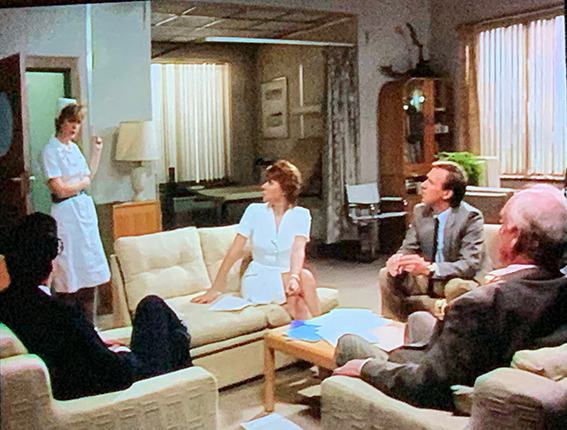
I recently posted about reading, for the first time, A Very Peculiar Practice by Andrew Davies. It was great read and certainly means it will be charging up the essential league table of the best campus novels next time it is updated.
As I noted before it has been a long time since I’ve seen the TV series and I was a bit worried it would disappoint but it absolutely did not.
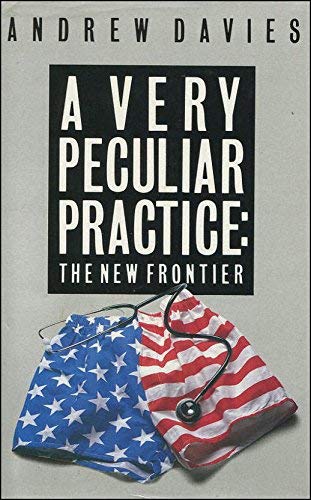
Anyway, following this positive experience I felt duty bound to track down the sequel. I harboured similar anxieties about the possibility of disappointment second time around but I’m pleased to report that A Very Peculiar Practice: The New Frontier is as entertaining and darkly comic as its predecessor. The key personnel in the Lowlands University Medical Practice are as before except that Dr Stephen Daker has been elevated to head up the practice.
New VC, New Vision
The grim higher ed environment portrayed in the original novel is still there as backdrop but with a new Vice-Chancellor in charge things are moving in a very different direction as the blurb sets out:
Lowlands has a new American Vice-Chancellor, Jack Daniels. Handsome, blue eyed, virile, he has a vision of a Brave New University, spearheading the New Knowledge, but also embodying the great eternal values of the Free World. And not only has he the vision: he has the funding too.
The medical team respond to new challenges, treating patients for such new ailments as malnutrition, industrial injuries, and Temporary Threshold Loss. Dr Rose Marie, for example, funs a Male Sexuality Workshop which renders its male members incapable of further misdeeds. Jock McCannon, deeply suspicious of the new regime, finds that the sap still flows in his whisky-marinated old bones. And Stephen falls disastrously for Grete Grotowska, the abrasive art historian, an authority on the male nude but a pill in bed.
Andrew Davies’ comedy is as sharp and funny as ever, but his vision of Britain in the late eighties is an alarming one. Lowlands University was dreadful enough as an exhausted repository of shattered dreams; as an Anglo-American success it is hilarious but terrifying.
There are some entertaining contemporary parallels in the descriptions of Lowlands and the novel strategies pursued by its thrusting Vice-Chancellor, but perhaps the most surprising thing for me is the sheer frequency of Senate meetings. Daker, invited to join Senate by the VC, is largely mystified by proceedings (most people would be) but they do seem to be having meetings every couple of weeks.
The inauguration of the Vice-Chancellor is nicely reported and it is noted that the University’s Great Hall of Lowlands was packed for the VC’s inaugural address with many robes of “bizarre splendour” and generally in inverse ratio to the prestige of place of origin:
Most of the flashy regalia emanated from such dim and suspect institutions as Lampeter, Sauchiehall, Rutland, Porterhouse and Lowlands itself…while places of solid achievement such as UCL and imperial College decked out their graduates and doctors much more soberly.
Stephen in his modest Birmingham MB robe was “quite overshadowed by Professor Piers Platt of Art History, who was glittering in some sort of medieval finery he had conned out of the University of Siena.”
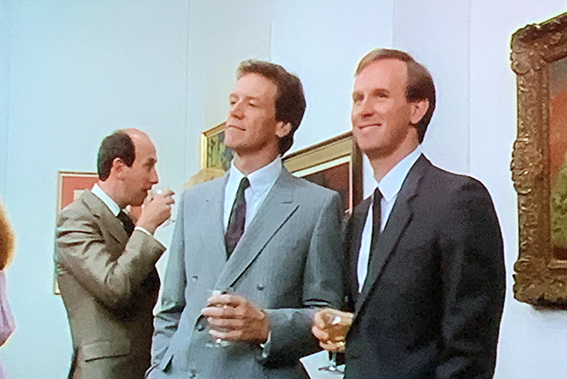
It was never going to end well
As previously we have the repeated appearance of a pair of nuns on campus, always doing something rather strange. No meaningful explanation is ever provided for this but they do offer a regular reminder of the absurdity of the whole enterprise.
This commentary on the series by Neil Martin1, published in the very serious journal Comedy Studies, also covers the second novel:
‘We’re going to make the earth shake here at Lowlands’, says the VC. Or, as Jock alternatively puts it, ‘The University of Lowlands has sold itself to the Prince of Darkness’. Jack Daniels, again, is a bit of an in-joke because one the wealthy benefactors of Warwick University where Davies taught English, was Jack Martin who ran the Smirnoff empire and whose name is attached to an existing Hall of Residence at the University (Shattock and Warman 2010).
It is a cliche to describe generally grim and authoritarian contexts as Orwellian but this series justifies that description with its thuggish private security guards on campus, the besuited bodyguards in glasses, the axing of financially under-performing departments, and the drive to remove human obstacles if they are not perceived to follow University-think. Episode one (‘The New Frontier’) opens with scenes of cactopian squalor on campus – students coughing, living outside in tents, later reporting malnutrition to medical staff because they cannot afford food because of university rents. It is all exaggeration but it is hyperbole for comic effect and it falls just the right side of plausible.…this series ends more apocalyptically than does the first with rioting, violence and the University closed entirely. In episode 7 (‘Death of a University’), the final scene sees the University of Lowlands becoming ‘Lowlands High Security Defence Research Establishment’. Grotowska and Daker have a child and the final shots sees Stephen lament: ‘It could have been such as good place you know. It could have been really…OK’.
It’s a grim prospectus for the future of universities of this type. With all the talk of possible closures now I do hope this does not turn out to be prescient. And of course all this happened quite a few years before the days of UK universities recruiting internationally for their Vice-Chancellors (including Warwick which did have an American VC for a period).
Senate and the students’ union
As noted above there seem to be rather more Senate meetings than you would expect and Stephen, having been invited to join this august body, struggles to make sense of the language, power structures, debate and agenda. Despite the vocal opposition from senior professors in the Arts and Social Sciences (including threats to write articles about the changes for The Times, Guardian and THES) the VC does rather dominate the Senate:
A few days later, Jack Daniels let Senate in on the way things were going to go. He gave it to them square-jaw, frontier style. Tall in the saddle….As a consequence of Lowlands’ success in achieving top league status for research excellence, he explained to the assembled assholes, he had to accept a certain amount of rationalization in certain areas, mainly affecting undergraduate intake and staffing in arts and social sciences. Naturally all present courses and commitments would be honoured. The Vice-Chancellor still held to his vision of a Platonic community blending the best of all the arts aand the sciences…But the only wat to achieve it was for the university pay its way , all the way down the line, which had meant taking some very difficult decisions. He referred the assholes to the details outlined in Senate Paper 42…
This really gives a flavour of his views of his senior academic colleagues. Interesting too is the way the student voice is neutralised, at least partly, by the president of the students’ union, Harry, being bought off by the VC who keeps providing him with ever nicer cars.
At one point Stephen goes to see Harry and “He was rather disconcerted to find that the office of the President of the Students’ Union was only marginally less luxurious than the Vice-Chancellor’s.” In addition to some young men in double-breasted suits lounging around who did not look like students “There was a case of claret on the desk, with the name of a smart Pall Mall wine merchant on it, and several opened bottles were dispersed around the room.”
One of the sabbs observes that he hasn’t met Dr Daker before:
“No, you Union officers must be very healthy people.”
“Ah, well, you see,” said Harry, “sabbatical post-holders get BUPA, brought that one in my first term of office.”
Will there be any more peculiar practices?
Unsurprisingly perhaps, this sequel will be joining its predecessor at the upper end of my list of favourite campus novels. I’d definitely recommend both books as good reads in the current context.
Finally, I did want to note the significant profile in this book given to the head of security at the university. As I have long argued this is one of the most important roles in an institution and it is pleasing therefore to see the coverage here. Although I have to say he doesn’t seem that similar to heads of security I’ve had the privilege to work with over the years. Anyway, the Lowlands University Head of Security takes his job very seriously indeed, such that he acquires a firearm which he keeps in small harness which is far too tight and which he wears under his jacket. On consulting Stephen about this he says:
“Don’t suppose for a moment you have considered going armed yourself.”
“No, I haven’t, ” said Stephen, intrigued. “Do you think I should?”
“Why bother? You’ve got me to look after you.” He buttoned up his tunic. “You’ve no idea what goes on in this place. Ha! I could write a book, Dr Daker. I could write a book!”
It would be great if someone, someday, did write a book about the security incidents which happen at a university. You could call it something like, I don’t know, True Crime on Campus. Wonder if it would take off? Maybe not, but let’s hope there will be future campus novels which measure up to the standard of the two Very Peculiar Practice books.
- G. Neil Martin (2023) A Very Peculiar Practice: a very modern campus comedy, 35 years on, Comedy Studies, 14:1, 2-19,
 The Wonderful (& Frightening) World of HE
Leave a comment