
Or Snog, Marry, Avoid?
The latest PA Consulting survey of vice-chancellors (40 responded) contains some interesting observations about the state of the higher education.
One particular eye-catching comment related to what was described as a mixed attitude to institutional mergers:
Vice-chancellors express mixed attitudes towards institutional mergers. Contrary to media predictions of a wave of mergers and takeovers due to market turmoil, the majority of vice-chancellors don’t anticipate system-wide restructuring. While one in five institutions are actively exploring potential mergers, 60 percent have no current intentions in that regard. Interviewees agree that most mergers are, in practice, take-overs of a struggling provider by a stronger partner. They are inherently expensive, complicated, and time-consuming, representing unwanted distractions to institutions already managing their own challenges.

One vice-chancellor was quoted as saying:
“Mergers […] are challenging, taking time and significant resource and should be contemplated before financial position dictates it. Other forms of collaboration are probably more attractive and more likely.”
I must admit to being surprised at the comment that one in five institutions are “actively exploring” mergers (although this means only eight VC responses in this survey and may not be wholly representative) which you could argue supports the media narrative rather than challenging it.
Anyway, there is still clearly lots of talk about mergers as well as the more likely scenarios of different kinds of collaborations and alliances.
Mergers – Both Rare and Commonplace
As the VC quoted above rightly notes, mergers are difficult, expensive and time-consuming. There really aren’t that many around to talk about. The landmark mergers in UK HE over the past 40 years are not large in number and include combinations which have led to the establishment of the University of Manchester, London Metropolitan University, the University of South Wales, Trinity St David, the University of Cumbria, the University for the Creative Arts and most recently City St George’s.
So, it’s clear that there aren’t many mergers of note then. But if we look further back, as Mike Ratcliffe did some years ago, in a piece on mergers, we find there is actually a lot more going on. He estimates that of the 140 HEIs which were on HEFCE’s books in 1994 over three quarters had been involved in some form of merger during their history. Of particular note are the bringing together of colleges to form the polytechnics in the 1960s, the merger and closure of colleges of education in the 1970s and the absorption of colleges of nursing, midwifery and other health professions into universities in the 1990s. So, whilst mergers are rare then they are also, over time, not that uncommon at all.
Some Timely Guidance
I was recently reminded of a paper which included the following topical observations:
The pace of change in the HE sector is probably accelerating in many countries due to a number of complex and interacting factors, such as globalisation, internationalisation, the growing role of the private sector, increasing use of international rankings of institutions, and changing student needs and expectations.
Institutions are being challenged as never before to reconsider their fundamental role, market position, structures, relationships, partnerships, policies and processes. They will need to continue questioning how they operate internally, engage externally with other institutions and organisations, and interact with the wider society. This raises the profile and potential relevance of collaborations, alliances and mergers as part of institutions’ response to the drivers for change. Nonetheless, institutions are autonomous and there is no question of a top-down approach in England.

It is in fact a HEFCE report from 2012 on collaborations, alliances and mergers. Although we are a long way from 2012 there is a lot of relevance in here. The document presents a pretty straightforward classification of activity into collaborations, alliances and mergers:
• Collaboration: two or more partners working together in a particular area of business, which may involve combining existing operations, pooling areas of expertise or creating something entirely new. This project focuses on institutional arrangements rather than relationships between groups of academics. There are many different forms of such collaborations, as indicated in Figure 1: examples include joint research institutes or joint faculties, which might have their own distinct brand. Sometimes collaborative ventures are known as partnerships or co-operation agreements. In this report we discuss the general characteristics of these various forms, so that we can compare them with mergers.
• Alliance: a more systemic form of collaboration between two or more partners, covering a wider range (but not all) of their operations, where the partners retain their separate identities.
• Merger: two or more partners combining to create a single institution, which may retain the name and legal status of one of them or be an entirely new legal entity. In the ‘holding company’ model, one institution can have subsidiaries that retain separate names, brands and operations, to varying degrees. Federations can be seen as a more flexible version of full merger.
This ‘CAM spectrum’ ranges from softer associations or consortia to shared services, joint ventures all the way through to harder full mergers and is summarised in this diagram:
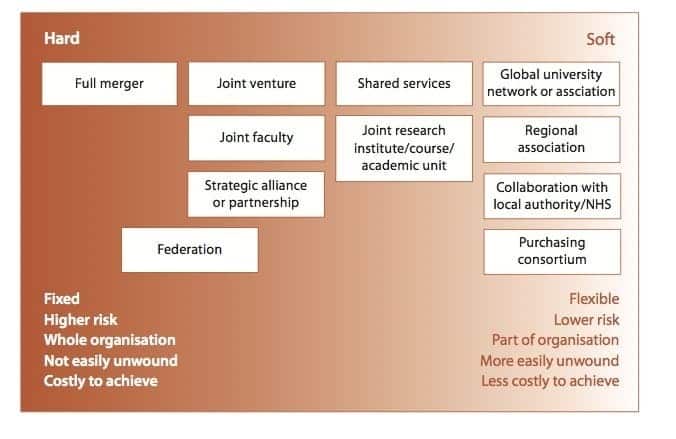
It’s a helpful way to think of the range of possible forms of collaboration or alliance. Which naturally got me thinking, what as yet unexplored possibilities there might be for alliances and partnerships of one form or another in the UK sector. And so…
New Groupings, Alliances and Collaborations – But Not Mergers
There are lots of exciting new options here for universities across the country to work together in novel ways in these most challenging of times. So as an entirely frivolous and diversionary activity, I wanted to suggest some new possible arrangements, groups and networks. Just a bit of fun and please do not take any of this seriously. Here then are some of my suggestions:
The Chesters
Manchester, Manchester Metropolitan, Winchester, Chichester, Chester (the founding member) and new arrival Greater Manchester.
All Points
Northumbria, East London, Southampton Solent (reflecting enthusiasm for its new direction), West of England and West of Scotland.
The Hamptons
Northampton, Southampton and Wolverhampton.
Blue Bloods
Queen Margaret, Queen Mary, King’s College London, Royal Holloway, Queen’s Belfast, Royal Agricultural University, Royal Veterinary College, Regent’s and Kingston.
TLA (Three Letter Acronym) Alliance
Those universities for which long words are just too much: UEA, UCL, LSE and BPP.
Spelling and Pronunciation Fun
Worcester, Gloucestershire, Loughborough and Leicester.
Nautical Terms
Hull, Keele, Portsmouth, Leeds and, ahem, Luffborough
The Abers
Aberdeen, Abertay and Aberystwyth.
X Factors
Essex, Sussex, Exeter, Wrexham and Middlesex
A Real Mouthful
Portsmouth, Plymouth, Plymouth Marjon, Arts University Plymouth, Falmouth, Arts University Bournemouth and Bournemouth
Don’t Forget the Apostrophe
King’s, St Mary’s, Queen’s Belfast, City St George’s and Regent’s.
Associated with Men Possessing Impressive Facial Hair
Brunel, Leeds Beckett, De Montfort (assumed), Napier and Anglia Ruskin.
First Name Terms
St Andrews, Robert Gordon, Queen Margaret, St Mary’s, York St John, Trinity St David, Liverpool John Moores and Queen Mary.
The Building Society Group
Swansea, Suffolk, Nottingham, Cambridge, Loughborough, Buckinghamshire, Manchester, Glasgow, Bath, Coventry, Newcastle and Leeds.
All The Umbrians
Cumbria and Northumbria
Fighting Old Battles
York, Reading, Worcester, Stirling, Northampton, Edge Hill (albeit in an entirely different location), Leeds and Aberdeen.
One Syllable is Quite Enough
Kent, Law, Leeds, Hull, York and Bath
We Do Like To Be Beside The Seaside
Brighton, Aberystwyth, Swansea, Falmouth, St Andrews, Portsmouth, Plymouth, Southampton, Essex and Bournemouth.
University Crests Featuring Lions Rampant
St Andrews, Durham, Birmingham, Bangor, Newman and Imperial. (Note – not to be confused with those featuring lions passant or dragons rampant, passant or indeed combatant)
OK, that’s quite enough of that nonsense. No doubt there are other emerging made up consortia, collaborations and alliances we’ve missed. Do feel free to add them below.

 The Wonderful (& Frightening) World of HE
Leave a comment