Car parking discussions tell you a lot about HE
For a number of years when writing for Wonkhe I was involved in preparing the essential annual car parking rankings. These began as fairly crude league tables but developed into highly sophisticated rankings under the committed direction of David Kernohan. And, as you can now see, they are the equal in accuracy and methodological credibility of any of the national or international league tables out there.
The enduring popularity of these rankings is testament to the central place of car parking in university life. Clark Kerr, former President of the University of California, famously captured the essence of university life in this description:
The university is a series of individual entrepreneurs held together by a common grievance about parking.
On everyone’s agenda
Car parking is one of those things that everyone has a view on and almost everyone has some form of problem. It feels like it is such a fundamental issue and therefore concerns about parking are often the things that all people across campus, staff and students, visitors and contractors, feel most strongly sbout. Attend any kind of open forum, town hall or other session with senior management in a university and you are almost guaranteed to hear questions and concerns raised about parking. The cost of permits and daily charges, availability of spaces, the unfairness of charging models, lack of consideration for those working shifts or with caring responsibilities, proximity of parking opportunities to an individual’s workplace, lighting and security – this are just some of the issues which you will hear about if car parking is on the agenda.
Many years ago the university I worked at had an excellent paper based filing system. One of those files, which was, I think, numbered something like ZZ99 although I may be wrong, contained all the letters from people who wrote only in green ink or were convinced they had discovered time travel. There was quite a bit of this kind of material and it was always a good source of entertainment when you had to visit the otherwise less than exciting filing office. But a large chunk of this file was taken up with correspondence from an academic colleague complaining about his treatment in the car park. He appeared to have had endless tribulations in seeking to secure a spot without somehow encroaching on a yellow line or not having the right ticket. It was a never-ending set of exchanges with various members of the estates team which demonstrated just how passionately people can feel about this fundamental issue. This was a completely sane and rational member of staff who really did have a massive gripe about parking but who was unaware that all of his concerns had been consigned to the ZZ99 file rather than influencing parking operations and policy. I’m hoping everyone has got over it by now.
The story of everything?
Whilst you can learn a lot about university life from examining the issues around car parking it is all too easy to draw mistaken conclusions about wider HE matters from the policies and practices which might be in place. A piece in the London Review of Books in 2024 does just that. Essentially, the author is pining for a golden age – of parking and higher education – when everything was free and it was easy to park. No payments, apps or permits required and life was good. Now though, everything is hell, you can’t get parked anywhere because all the spaces are taken or reserved for students or senior managers and there are strong incentives to take other modes of travel if possible. All of this apparently points to the peripheral status of the core activities of learning and teaching versus the increasingly vital issue of paying for parking:
It occurred to me that the clues to all this – to the nature and priorities of the modern university – were there already in the car park. In the hierarchy of worth, senior management and business ‘partners’ are at the top, both of the institution and the multi-storey. Then there are prospective students, who are valued highly (if instrumentally) for the fee income they represent. Then actual students (less important because they are already in the bag, but important to retain and also to milk for rent). Then, at the bottom, there are academic and other staff, who represent a costly inconvenience (though one that cannot be eliminated entirely).
One of the stranger things about the atmosphere of the university today is that its supposed central functions are increasingly peripheral, its peripheral ones increasingly central. Sports centres and pudding bars and entertainment expand as offices and teaching rooms contract. The actual teaching and learning, which throughout Welcome Week we tell students is the heart of the university and their main concern (if you have to say it, it probably isn’t true), feel increasingly like a sideshow, something that happens in the gaps and against the odds.
This really is a stretch. And the idea that universities are only concerned with students for the fee income they can offer and milking them for rent and therefore will coddle them with car parking opportunities is just silly.
A survey of student views on parking in US universities conducted a few years ago and reported by Inside HigherEd highlighted the concerns of many about their access to secure and affordable parking.
An extract from the infographic gives a flavour:

This student view is regularly discounted in the discussions which happen in UK universities as it can often be the case that parking space is so restricted that students are simply not allowed to bring cars to campus, apart from in very particular circumstances.
Car parking really costs
Again in the US, this podcast from the Chronicle, covers a lot of the issues around parking and is well worth a listen (or a read of the transcript). The discussion with Adrienne Tucker. the director of parking and transportation at Kansas State University, is a particularly informative segment. Having accepted that people in her role are never going to be popular on campus she sets out how the parking operation has to cover its own costs:
Adrienne Tucker We do not take money from the university to operate. So we do not get money from student fees, tuition or anything else that the student gives the university. We are entirely self-funded, 100 percent. So their parking permit, the fees that they pay for their parking permit, go towards lot maintenance. And you’re looking at anywhere from eight to thirteen thousand dollars per stall just to do a mill and overlay in a parking lot. You’re looking at a couple hundred grand in garage maintenance every year…. So if you want nice parking lots that aren’t full of potholes, that are well painted, that are well lit, that have good signage, you have to pay for it.
Jack Stripling But is it a revenue generator for the university? Or are you saying no?
Adrienne Tucker No. No, the university doesn’t take our money per se. So, for example, I have a bond on, my office here is in a garage. I have a bond on the garage, so I have a bond payment I have to make every year. And it’s about $1.1 to $1.2 million every year. The university requires me to have on hand $1.5 million in the bank to help cover the bond payment and any other maintenance or any other concerns that happen if I were to suddenly find myself without revenue, like we did during COVID, and the university shut down. So take that right off the bat. I might have two million dollars extra from permit sales, but then I, right now, I have to rebuild parking lots. I have to rebuild roads. I have to put in new curbs. I need updated lighting in my parking lots. I need to put a new camera system in my garage.
Jack Stripling So is nobody getting rich off parking at Kansas State?
Adrienne Tucker No, no. Not even a little.
It’s a really interesting set of insights and reinforces the point that no service on campus is free. Everything costs and has to be paid for one way or another. The golden age of parking on campus, where anyone could bring a car, always find a space and never had to worry about paying for it really has gone, if it ever really existed. But campus car parking is still something which will continue to get lots of people excited.
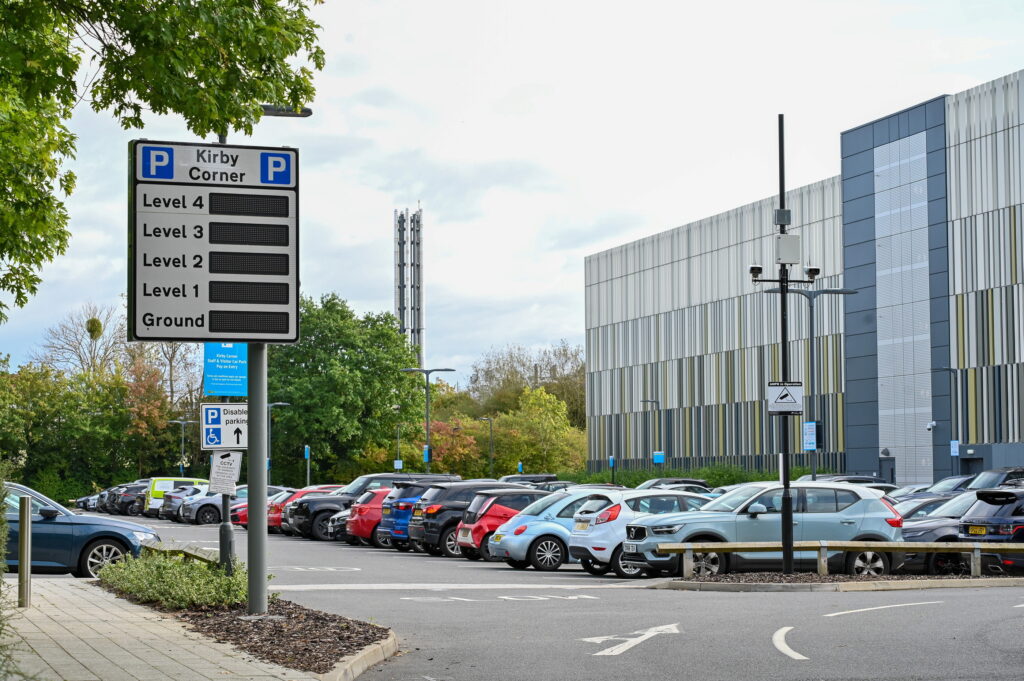
(The picture at the top of this piece is of Kirby Corner car park at the University of Warwick which won the enormous accolade in 2023 of being named Britain’s best car park by the self-proclaimed dullest man in Britain.)


 The Wonderful (& Frightening) World of HE
Leave a comment