Branding battles: think before you sue
Some years ago I wrote on Wonkhe about the thorny issue of university branding and logos and the potential for conflict with staff, students and alumni about such changes which they generally dislike. Sometimes with good reason though.
What Inside Higher Ed recently identified though was a perhaps surprising enthusiasm on the part of some institutions to go to law when they felt someone else was pinching their logo. It’s all about avoiding brand dilution apparently. This piece has some great examples including one of my favourites , the case of Duke University, which was very upset recently when the popular TV series White Lotus (season 3, not the best but still very good indeed) included a protracted sequence where the actor Jason Isaacs was having some very dark thoughts about the future of his life and holding a loaded gun. It was serious stuff and the university told CNN they were not happy:
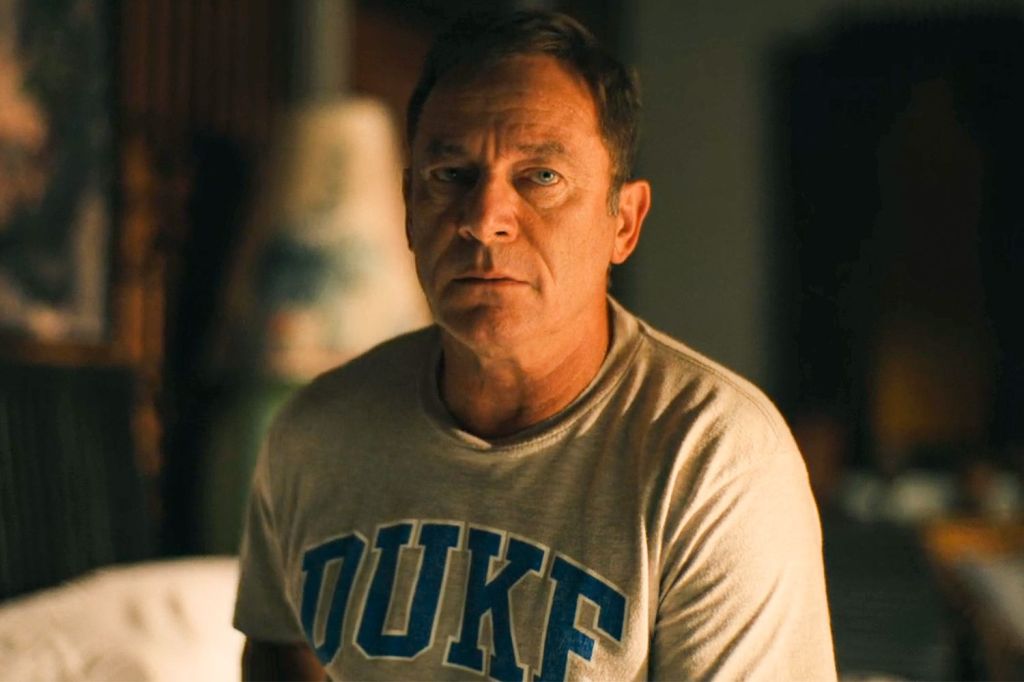
“Duke University did not approve the use of its marks in The White Lotus,” Frank Tramble, the vice president for communications, marketing and public affairs at Duke, told CNN in an emailed statement. “Duke appreciates artistic expression and creative storytelling, but characters prominently wearing apparel bearing Duke’s federally registered trademarks creates confusion and mistakenly suggests an endorsement or affiliation where none exists.” Tramble added that the show “not only uses our brand without permission, but in our view uses it on imagery that is troubling, does not reflect our values or who we are, and simply goes too far.”
I don’t think the matter was taken any further though (and remarkably no-one seems to have complained about Issacs’ accent).
One of the bigger legal tussles noted in the piece is between Baylor and Boston Universities:
Baylor, located in Texas, alleged in its lawsuit that Boston U, nearly 2,000 miles away in Massachusetts, violated a nineteen eighty eight agreement on the use of its interlocking BU logo. Baylor argued that Boston’s use of the interlocking BU logo is “likely to cause confusion, to cause mistake, or to deceive consumers and potential consumers.” The two logos, while in different colors, are visually similar, and many of their products are sold on the same websites, the lawsuit noted.
Baylor’s lawsuit notes that Boston began using the interlocking BU logo in 2018, some 30 years after agreeing not to. The Texas university pressed Boston on the matter in 2021 but alleges that not only did the other BU not drop the contested logo, but it also expanded its use to more merchandise.
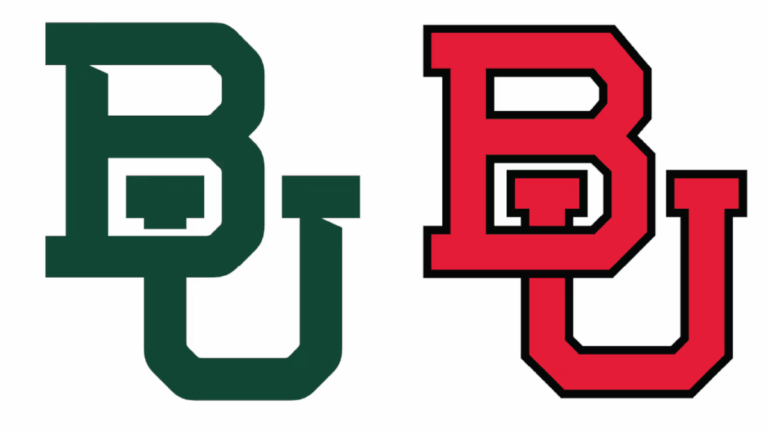
Although Boston appears only to use the logo for its sports teams and the very different nature and geographical location of the institution means they are unlikely to be confused by anyone, the concern seems to be that if Baylor let this kind of thing slide then it makes it much easier for others to do in future.
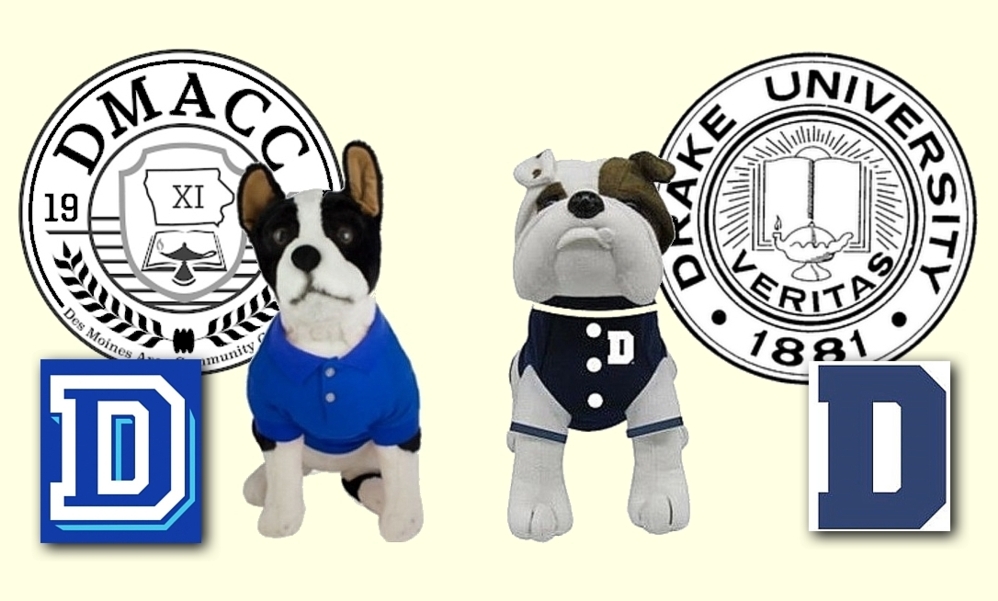
A not dissimilar case occurred last year when Drake University sued Des Moines Area Community College about its rebrand which it claimed was too close to its own. As you can see, Drake has strong focus on a big letter D and a dressed up dog mascot.
It seems Drake won this one although again there probably wasn’t much chance of the two institutions being mixed up by anyone.
Whilst you might expect universities to sue companies for misuse of their logo it is perhaps surprising when it happens the other way round. According to Inside Higher Ed:
earlier this month Columbia Sportswear filed a lawsuit against Columbia University, with the apparel company accusing the Ivy League institution of breaching a 2023 contract between the two entities, trademark infringement and unfair competition. That lawsuit is ongoing.
Seems a bit harsh.
But the best examples of all of this kind of thing reported in the article are when universities get it really wrong:
Last year the University of Cincinnati sent Cheatham Middle School in Tennessee a cease-and-desist letter for using UC’s Bearcat mascot, a similar logo and other signage.
Officials at the middle school, which had used the contested logo and name for decades, said they tried to strike a compromise by adopting new imagery but keeping the Bearcats moniker (which is used at multiple K–12 schools across the country). But Cincinnati allegedly denied that request.
Critics accused Cincinnati of being overly sensitive and unnecessarily litigious, arguing that no one was going to confuse a middle school in Tennessee with a university in Ohio. Ultimately, Cheatham Middle School rebranded as the Musketeers, adopting the same name and a similar logo to the one used by Xavier University, Cincinnati’s cross-town athletic rival.
Cincinnati spokesperson M. B. Reilly defended the move in an email to Inside Higher Ed, writing that the middle school “appropriated UC’s identity in a variety of ways” beyond the name and accused CMS officials of posting “inaccurate information” as it sought to resolve the issue.
“Overall, we appreciate interest in using UC’s iconic trademarks, which are recognized both nationally and globally. But we ask that entities seek permission to do so,” Reilly wrote.
Taking on a school really is not a good look. Even worse though is getting legal with a bakery:
In 2012 the University of Alabama sent a cease and desist letter to Mary’s Cakes & Pastries, a local bakery, that sold cookies with houndstooth-pattern icing, or with footballs and elephants or a big “A.” The bakery also made special-order cakes decorated with Crimson Tide themes.
The legal action prompted outrage and ridicule, with one local telling The Tuscaloosa News that the university was “acting like a greedy shrew defending a girlie Script ‘A’” in the brand battle. Alabama soon backed off amid the backlash, and a university official called the bakery to apologize.
All of this points to the need to be a bit more sensible about this kind of thing. As Carol Keese, VP for communications and chief marketing officer at the University of Oregon, puts it in the article:
“I think you need to take a measured strategic approach that understands where your brand is most at risk, where you need to lean in to protect it and grow it, and where you can have a conversation with an organization, or make a deliberate exception for a local bakery shop,” Keese said. “That’s the kind of relationship management that’s also part of your brand.”
So, think before you sue. Sensible advice.


 The Wonderful (& Frightening) World of HE
Leave a comment