
It’s Always Too Early to Speculate
I recently speculated – drawing heavily on others’ insights – about what might be in the forthcoming Post-16 Skills White Paper and threw in a few optimistic ideas about reducing the cost of higher education regulation.
Whilst many have ambitions for the White Paper which go well beyond the modest aim of reducing the cost of higher regulation and revising the regulatory regime I would still argue that if such changes were made as part of a broader set of proposals then at least some modest resources would be released to help address other financial challenges.
The HE sector needs changes which deliver a much more efficient and cost-effective regulatory framework, overseen by a refocused OfS, which will give us a long term model which works for students, institutions and other stakeholders. A high trust, proportionate lower-cost regime would mean universities are significantly better placed to make the greatest contribution to delivering the broader skills and growth agenda which are expected to be at the heart of the White Paper.

But it does now seem that the White Paper is just taking longer than everyone expected. Indeed it may now be very late in the autumn or even the new year before it actually appears. This is a concern but if it contained everything that everyone was hoping for it might not be such a problem. I must admit though to being a little sceptical about what is actually going to be in the White Paper which will be of significant benefit for higher education. The longer this all drags on and the more extensive the ambitions and the wish lists then the greater the disappointment will be.
We might get a bit of tinkering and some tidying up of legislative loose ends but it just seems more likely that there will be slim pickings in there for HE. And there certainly won’t be very much in the way of cold hard cash.
This all feels terribly short term therefore.

All I Want for Christmas is a New Higher Ed Review
In the absence therefore of substantive concrete changes to address the manifold problems faced by the sector the government could consider whether it might be time for one of those once-in-a-generation great big higher education reviews. This would allow everyone to express an opinion and make it look like government really cared about the sector and was taking its future very seriously. It also buys them some more time as these things normally take quite a while to get going and then report.
Back in June 2024 Alistair Jarvis observed that
the Labour manifesto made it clear that we can expect significant policy, funding, and regulatory change for universities and the broader post-16 education sector.
He suggested that this might take the form of a full-blown review which would cover all of the major HE bases. There is, as we all know, a lot to go at.
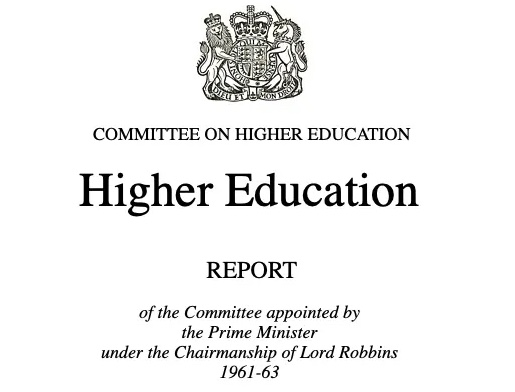
The only slight problem with this seemingly outstanding notion is that, since the Dearing review in 1997, which is the only one which has felt close to having the impact and resonance of Robbins from way back in 1963, any report has been inadequate in comparison. Browne made a bit of a splash in 2010, principally because of fee changes, but is otherwise little remembered and the most recent HE outing, the Augar review of 2019, is all but forgotten already. So doing a proper higher education review which delivers meaningful long term impact is really, really hard (see this ranking for confirmation).
Although the impact of major HE reviews has declined over time I still think there is an opportunity with the right chair, a strong and diverse panel and research team and some really tight terms of reference to do something special which would set higher ed on the right path for many years to come.
Those who argue against such a review though seem to have the upper hand right now. Let’s have a look at some of the key points which seem to have swayed opinion such that a review now seems rather unlikely. In no particular order of persuasiveness these are:
- Everything is just fine
- We all know what we are doing
- The funding model is just right for institutions
- The funding model is also just about right for students
- We have the right balance between private and public investment
- The regulatory regime is tickety boo
- It’s better to allow HE divergence across the four nations
- The HE market is all working just fine
- Dundee was a one-off
- There are other major export industries which will be able to deliver the economic benefits the country desperately needs
- If the sector has to shrink then so be it – pulling up the ladder is completely reasonable given that there are pensions to be protected
- When the public loves universities this much why risk rocking the boat
- Student accommodation is planned, distributed and occupied in an entirely rational and affordable manner
- Some of those subjects deserve to disappear
- Research is just a luxury these days anyway
- The health service and defence of the nation can look after themselves
- Did we mention that everything is just fine?

Down to Ten Men
If I can’t have a major higher education review in my stocking this year then at the very least I would want what Professor Edward Peck, the new Chair of the OfS, mentioned in his recent speech to the UUK annual conference. He said that he would be looking to establish with the DfE
the policy and legal aspects of reimagining regulation of higher education in England for the 2030s.
That’s better than nothing and, if that piece of imagineering fails, I would hope that we could at least do what they are doing in Australia and review the regulatory framework.
All of this is fundamentally about taking a long-term view of higher education. As I argued a while back in this piece on ‘cathedral thinking’ for HEPI universities have to take a longer view on their role.
But this is difficult when governments struggle to see beyond the next election cycle and are focused on short term fixes. To ensure long-term certainty, universities ultimately have to take more into their own hands. This means a more vigorous defence of institutional autonomy while at the same time engaging with government priorities. It also means finding new ways to collaborate and to push back against the tide of excessive and burdensome regulation. Above all, though, it means taking a genuinely long-term view, regardless of whether or not we get a great result in a White Paper or a new higher education review for Christmas.
(With apologies both to fans of Half Man Half Biscuit and to those who have no idea what I am referring to here.)

 The Wonderful (& Frightening) World of HE
Leave a comment