
Taking a Further Step Towards Full Credit Transfer
Credit Accumulation and Transfer (CAT) has been around in UK higher education for a long time, indeed well over 40 years. This handy guide for institutions published by the QAA back in 2021 tells everyone all they need to know.
The effective operation of a CAT scheme is a key enabler for full implementation of the Lifelong Learning Entitlement. And, as we have recently been reminded on HEPI, LLE is due to begin in earnest in early 2027 but very few people know it is coming. There has been some focus on the funding mechanism and need for a functioning CAT system for it to work but it still feels like we are a long way from this.
There are of course other challenges and even if the sectoral environment were benign there would be some alarm bells ringing about this fundamental change to undergraduate funding model which is almost upon us.
A big step
Moving to a credit-based funding structure rather than one which assumes a full-time three- or four-year undergraduate degree as the norm feels like a pretty big step and it doesn’t not seem that everyone is wholly focused on it actually happening. On top of all of the other, pretty sizeable, challenges facing institutions at present this one perhaps does not look too concerning. But it really does not look like everyone is as well-prepared as they might be. One of the fundamental issues, as Rachel Reeds has recently pointed out on HEPI, is that student record and management systems (often the IT Cinderella) are not yet geared up to manage this very significant change.
While credit accumulation and transfer has been around for a long time and mobility between institutions based on credit transfer has been a consistent part of the HE landscape, if pretty small scale overall, for years too, there is still a general clunkiness about the whole operation. Despite the slightly futuristic way it is sometimes presented, credit transfer seems to operate in a bit of an analogue fashion in a much more digital world.
A minority sport?
Overall, mobility remains a minority sport but the credit principles which underpin it are about to apply to everything. For some institutions, as Helena Vine has observed in this Wonkhe piece, credit transfer is mainstream with, for example, the Open University managing 6,000 transfer applications a year. But for many other big institutions it remains an ad hoc process. Part of the reason for this is that, despite the superficial alignment of credit numbers, the receiving institution still has to map, in each and every case, the learning outcomes achieved by the transferee against those of the course they wish to join. This can make life pretty difficult for the student who is often required to do much of the work themselves or may find the receiving institution less enthusiastic about their potential arrival than they had hoped.
Not everywhere is like this of course and beyond the OU there are many universities and colleges which manage to admit students through recognising their credit without a fuss but the key point here is that the credit accumulation and transfer system we have is far from slick enough to cope with much bigger numbers of students looking to change institution for whatever reason. Whether mobility will grow because of the change to the funding model remains to be seen but in order for all of this to work as intended there does need to be a bit of a change sector wide.
Further measures needed
Scotland and Wales already seem to have made a bit more progress on this but as this report from QAA noted in 2025 there is a solid base in England to build upon as almost every institution uses the established credit scheme (we will step delicately around Oxford and Cambridge here). QAA recommended some fairly basic steps to enable fuller implementation. Its recommendations for providers included:
- All providers should make their recognition of prior learning (RPL) policies publicly available and easily accessible on their admissions web pages. Where referenced elsewhere, they should be hyperlinked for easy navigation.
- All RPL policies should include clear signposting to the support and guidance available to prospective students to help them meet the policy’s requirements.
Recommendations in the report for policymakers included:
- Use this credit transfer resource as an evidence base for any policy developments around credit transfer or the Lifelong Learning Entitlement.
- Encourage use of single, sector-owned template for RPL policies to ensure consistency. As is the case with the Credit Framework, this would be created and owned by the sector and QAA would act as the custodian of the template on the sector’s behalf.
There have often been calls for some form of regulatory or indeed legislative change which would somehow force receiving institutions to guarantee transfers to anyone turning up with the right number of credits. But the reality is that there has to be an academic decision at some point during the process to ensure that the student will actually have a chance to achieve a fair outcome on the course they are transferring into. Thus if a history student with 120 Level 4 credits from their first year at the University of Amersham is looking to transfer to the University of Bognor Regis to enter the second year of a degree in genetics, say, that is unlikely to work out for them. Absolute guarantees of transfers are not the way forward.
Transfer decisions are admissions decisions and are central to the idea of the autonomous higher education institution. Taking away some of the power to determine who is admitted and who is not would represent a diminution of autonomy and it is understandable therefore why universities are so reluctant to allow this to happen.
Acting collectively
But there are some steps which could be taken which would not require legislation or additional regulation. First, the English sector, guided by UUK, could come together to implement the QAA recommendations.
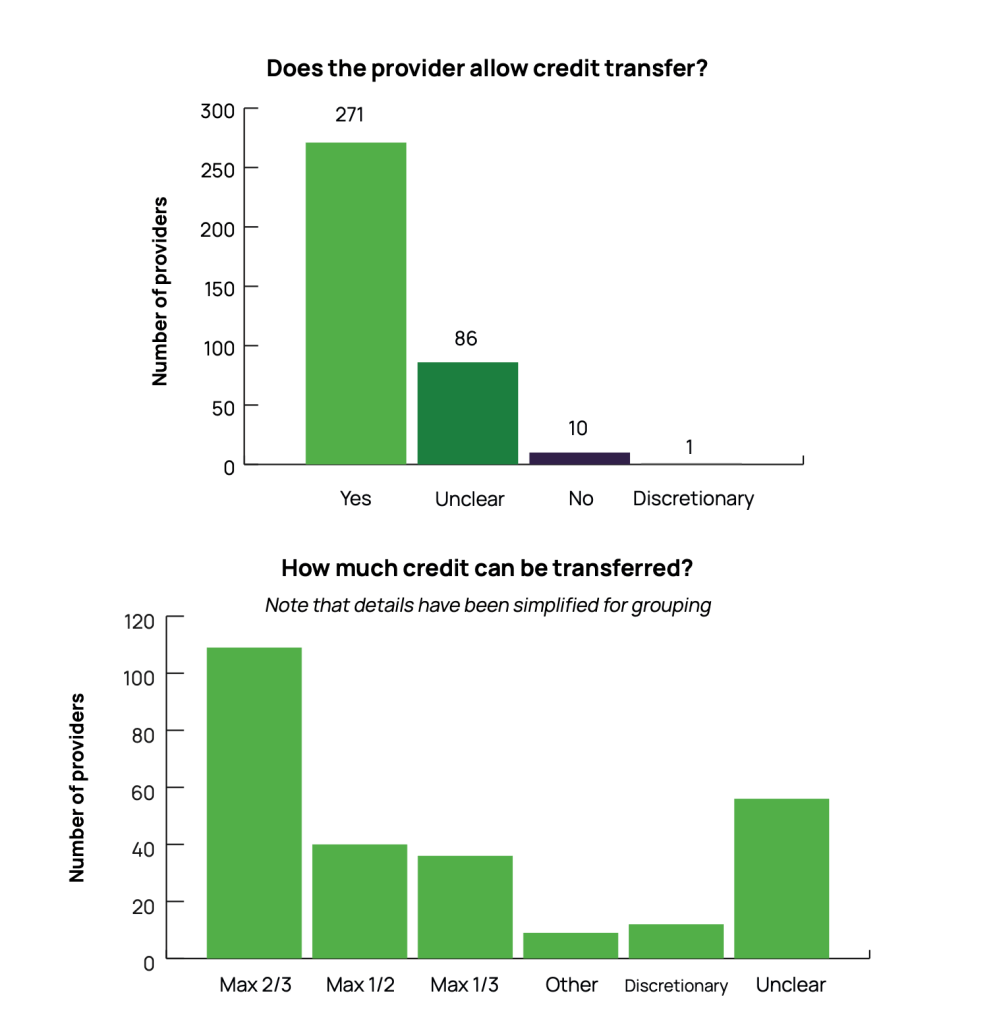
But there is also an opportunity to go further. This would involve not so much a sacrifice of institutional autonomy but more of an agreement to pool it. With UUK again holding the ring, institutions could agree that they will take the additional step of offering a transfer guarantee where there is broad alignment of curriculum followed and learning outcomes achieved. This, in reality, does not go a huge distance beyond where we are now but it does change the balance of power a little in favour of the student. Yes, the receiving institutions still retain the right to rule out some or all of the credit if it does not map BUT, if the presumption is for transferability then we are in different territory.
While the QAA survey on institutional openness to transfer suggests that the majority of receiving institutions will allow up to two-thirds of an award to comprise transferred credit,
One step beyond
A starting point would be for this guarantee to apply Level 4 credit only and/or up to one-third of an award. This may not make a huge difference but it at least means the sector is taking matters into its own hands rather than waiting for the regulator or government to act. And by taking such a step we will be delivering some of the benefits always been promised but never fully delivered by CATS. But doing students of the future a bit of a favour too.
 The Wonderful (& Frightening) World of HE
Leave a comment