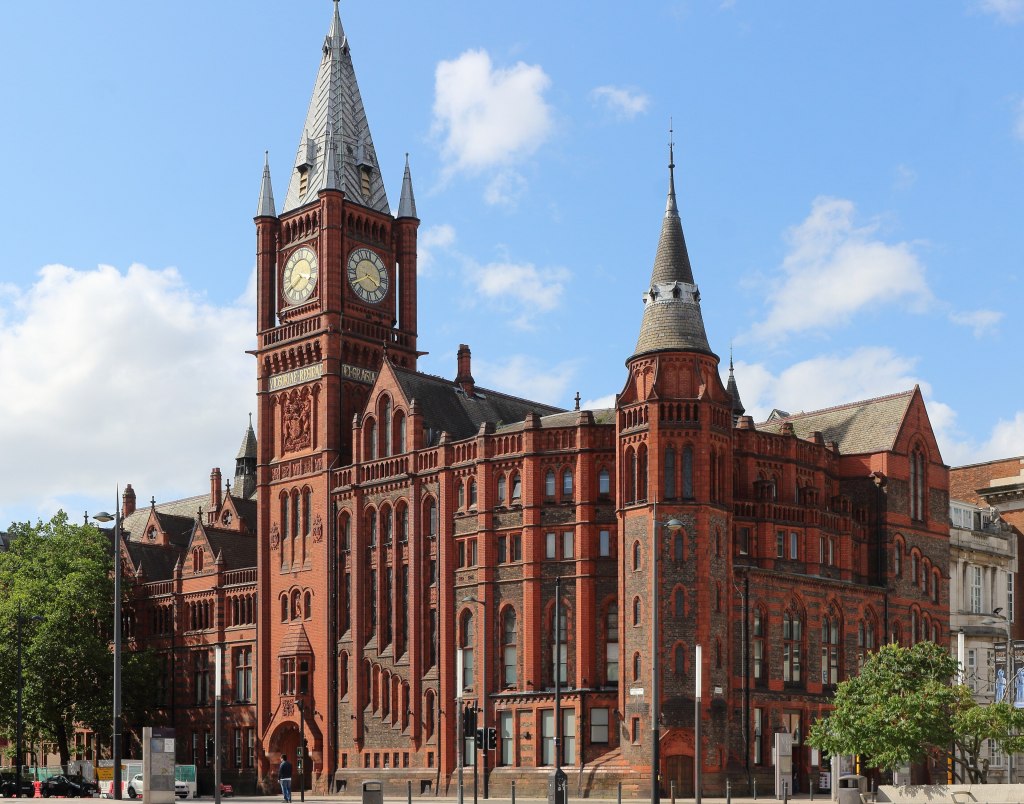
I’m a big fan of the campus novel. A while back I offered a ranking of the best campus fiction but there was, sadly, space for only one Malcolm Bradbury in the top 20. That is all going to change next time around as I have finally managed to read Bradbury’s debut publication, Eating People is Wrong. The plot is a simple one but the setting is everything:
Set in provincial academia (as were many of his novels which followed) forty-year-old professor Stuart Treece grew up in a bygone era of the 30s but now finds it difficult to adapt to the changing attitudes of the 50s. He then falls in love with post graduate Emma Fielding as he struggles to connect with her, agonising on his morals and his relationship to her. Also in love with Emma is an African Eborebelosa (who already has four wives) and adult working-class student Louis Bates, who is obsessed with her.
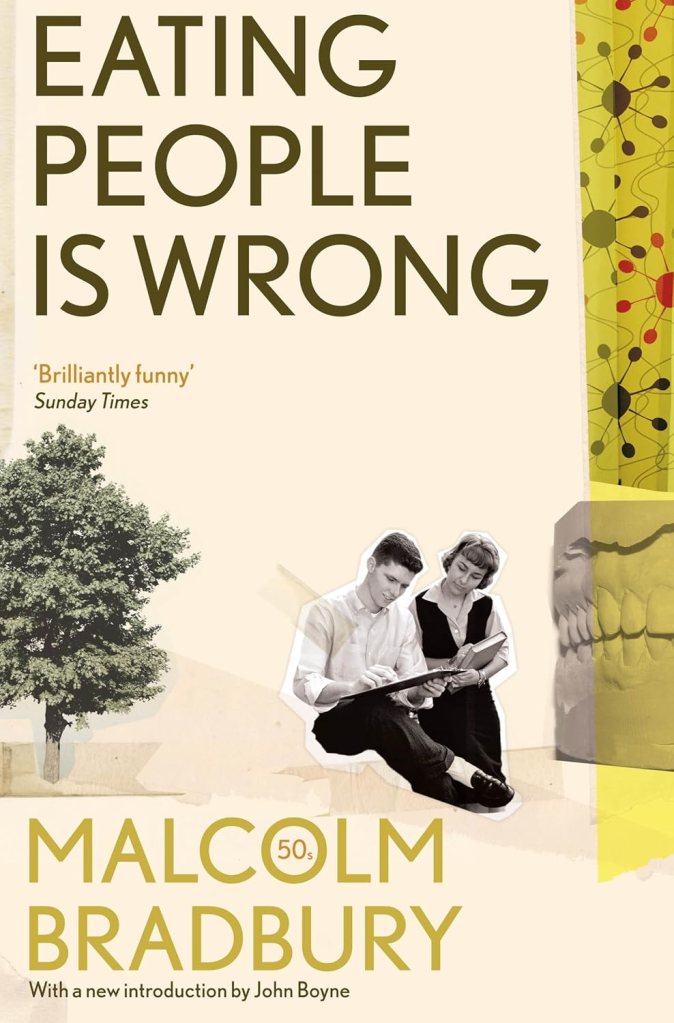
In an unpublished afterword, Bradbury explains
Eating People Is Wrong was a novel I had worked on right through the Fifties – indeed from the moment when I went to a redbrick university, a first generation student, and looked in wonderment at what I saw … If the central character, the 40-year old Stuart Treece, is based on anyone, it is simply a projection of my 20-year old self – though the last thing I intended, when I wrote the book, was to become a professor of literature like him, which either says a lot for the power of fantasy, or the ironic workings of fate.
He also notes that when the book appeared in 1959, it was described as a “campus novel,” and often compared with Kingsley Amis’s Lucky Jim. However, Bradbury says he began it “well before Lucky Jim appeared, and then wrote and re-wrote it several times during the decade.”
I have to say I enjoyed it a good deal more than Amis’s offering. There is a lot in it to enjoy and some of the observations of university life are really entertaining. The representations of the student Eborebelosa and the cultural differences arising are pretty crude though and something which really you would rather be done differently.
Some of the highlights
Treece asks his students if they have any creative writing they are working on:
No one responded. “No,” went on Treece, with a little sigh. “I suppose not. Of course when I was up at University, everyone seemed to have a novel or a sheaf of poems tucked away somewhere. It was that sort of time, of course – Auden at Oxford, Empson and Isherwood at Cambridge; there were so many enfants terribles that it was almost fashionable not to be writing anything.”
Treece reflects further
I suppose that kind of thing wasn’t so bad really. You don’t find it so much in the provincial universities, of course; people aren’t so concerned to make an impression, I suppose, and they come here to work and get a job, not have a good time or enrich their souls too much.”
Of course Bates should have gone to Nottingham, where all the members of the English Department have read Wittgenstein, Treece thought; the truth is, Treece had to admit, that I don’t want to get mixed up in this kind of thing. He said so.
In discussion with a colleague, Viola Masefield, Treece expresses reluctance to read modern novels:
“But you should,” said Viola.
“Why?” cried Treece. “I read this one because someone said I was in it. And I am. Do you realise that the story about the professor who left the script of one of his articles among some student essays, and another tutor gave it C minus, is about me? Someone must have told this man. Even down to the bit about, “This is good lower second stuff! It was B minus actually. That makes it worse.”
“Poet’s licence,” said Viola.
Treece’s world view is very much focused on the university:
“I disagree then,” said Treece. “I think a university is more than that. You know what the world is like now.” The world, in Treece’s view, was an ominous organisation; he had been fighting it for years now. The world was a cheap commercial project, run by profiteers, which disseminated bad taste, poor values, shoddy goods and cowboy films on television among a society held up to permanent ransom by these active rogues. Against this in his vision he was inclined to set the academic world, which seemed to him, though decreasingly so, the one stronghold of values, the one centre from which the world was resisted. He was as upset as the most devout of monks when people he knew “got mixed up in the world”; that was the end of their capacity for effective living. “Great Scott!” he said. “We of all people shouldn’t be asking what use a man is to the firm.”
And Bradbury reserves some special commentary for university leaders:
The Vice-Chancellor, like all vice-chancellors, had clear ideas of what a university should look like, and taste like; vice-chancellors all share in common a Platonic ideal for a university. For one thing, it should be big. People should be coming to look at it all the time. There should be a special place for parking Rolls-Royces. There should be big sports grounds, a science building designed by Basil Spence, and more and more students coming every year. There should be new faculties-of Business Administration, of Aeronautical Engineering, of Sanitation, of Social Dancing.
He goes further and, at a civic event, with the local worthies, he comments:
Vice-chancellors want big universities and a great many faculties; professors want small universities and only the liberal arts and pure sciences. Vice-chancellors always seem to win. Seeing Treece now, he left the local dignitaries whom he was buttering up at the bar, took Treece familiarly by the arm, and said jovially: “I think the little lady here has set her heart on you, my boy,” pointing to Viola, who was approaching. “Oh, Viola, nice dress; didn’t get that out here in the provinces, I’ll be bound. Changed your hair, too? Like it, Viola, like it.”
“Thank you kindly,” said Viola in a quaint voice. She turned to Treece and murmured, “Christ, can’t we get out of here?”
“Not yet,” said Treece.
“Come and meet the Lord-Lieutenant of the County,” said the Vice-Chancellor. “Very interested in boys’ clubs. Think he thinks this is one.”
There is much more of this kind of thing in the book which, if you have not read it, I recommend you do. I do think it is a really good early example of the genre. And, as you can see from these quotations, there are some entertaining resonances with contemporary higher education.
 The Wonderful (& Frightening) World of HE
Leave a comment