
Back in 2022 I commented on Wonkhe on a report produced by Humane (which I had been involved in) covering the roles of heads of university administration across Europe. For those unfamiliar with Humane, it is the organisation bringing together the administrative leads of institutions across Europe and beyond. Humane (of which I was honoured to be President for a short period a while back) is a terrific organisation which, in addition to producing reports like this, offers a range of outstanding professional development programmes for aspiring university leaders. You can find all the details of Humane here.
Humane has now produced a follow up to the 2022 report. Again based on a wide member survey this report draws on the experiences and views of heads of administration right across Europe. The context for this report is very different though and institutions in every country are facing budget challenges of one kind or another. Beyond the financial issues though there are new geopolitical uncertainties, the arrival of AI, different forms of online security concerns and, it seems, ever greater regulatory demands.
One of the particularly interesting observations made is this:
Several Heads of Administration note a striking paradox: their responsibilities continue to expand (even as budgets contract), and these are growing, as one observed, “inversely proportionally to budget reductions.”
I am sure this is a fairly widespread phenomenon, not only at head of administration level.
One other significant development is the continuing shift from operational management to a “greater emphasis on strategic leadership and organisational development” and the report also notes the different kinds of role:
Our analysis reveals several types of Heads of Administration: the Strategic Partner (fully integrated in the university executive leadership, with voting rights), the Chief Operating Officer (focused on operational excellence), the Faithful Second (the Rector’s trusted deputy), the Administrative Coordinator (managing without direct authority), and the Technocratic Specialist (an expert in specific domains). These types are not mutually exclusive as Heads of Administration often embody multiple models.
The report also notes the critical nature of the relationship with the Rector (President or Vice-Chancellor) but also observes that there is more of a tendency to split responsibilities and a move away from all areas falling under a single head of administration, perhaps at least in part due to issues of complexity and volume.
The authors highlight the genuinely varied origins of those surveyed as well as their differing career trajectories. In terms of their skills set, the report notes that
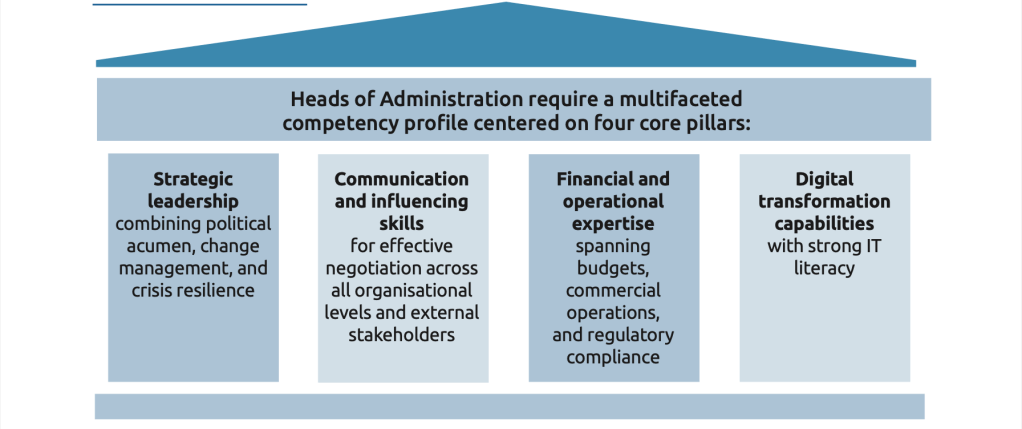
Critical current skills of Heads of Administration include political acumen and leadership, strategic and analytical thinking, communication and influencing, financial and operational expertise, higher education sector knowledge, functional domain expertise, and digital capabilities.
They also can operate as both intrapreneur and entrepreneur too and increasingly occupy
strategic positions at the intersection of academic mission and operational realities, which translate between institutional values and external pressures, collegial traditions and organisational efficiency, local identity and global dynamics. The role demands ever-broader skills: financial acumen and political sensitivity, strategic vision and attention to detail, the ability to lead transformation while maintaining stability, to champion innovation while ensuring compliance.
Given all of the challenges faced by institutions the report argues that the role of the head of administration becomes more critical. However, the suggestion here is that this vital function is under-recognised. Fortunately, Humane is on hand to try to help with that.
Other areas covered in the report include:
- Changing Governance in Higher Education in Europe
- National Contexts and Higher Education Legal Frameworks
- Executive Leadership in European Universities
- Role, Position and Place of the Head of Administration in University Governance
- Heads of Administration in Selected Countries
- Heads of Administration: External Roles and International Activities
- Background, Recruitment, Career Progression and Future Aspirations
- Salaries and Benefits
- Towards a Typology of Heads of Administration
There is also a hefty and useful annex which contains some quite detailed profiles of European countries and their higher education contexts.
All in all, it is well worth a read and if you want to get hold of a copy you can download it via the Humane website.

 The Wonderful (& Frightening) World of HE
Leave a comment