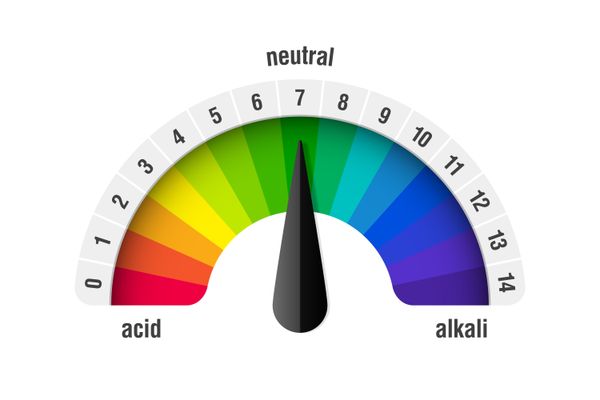
What is it with all this talk of institutional neutrality?
This recent piece on the Shakespeare Martineau website sets out some of the background to the issue of institutional neutrality. The current discussions have emerged from the broader free speech debate and Arif Ahmed, head of free speech at the Office for Students (OfS) has spoken and written about what he sees as the importance of institutional neutrality. Recently he was reported in the Times Higher in March 2026 as saying that “University leaders should “think carefully” about making political comments and institutions should strive for “neutrality.” At the core of Ahmed’s argument is that political statements on the part of higher education institutions “may be something that has a chilling effect on academics and students.” On Wonkhe, Jim Dickinson has vigorously countered the Ahmed line.
In April 2025 all UK university leaders were written to by a collection of academic freedom campaigners urging them to adopt a policy of institutional neutrality and suggesting it made sense to do so if they did not want to end up with a huge fine from the OfS like the University of Sussex.
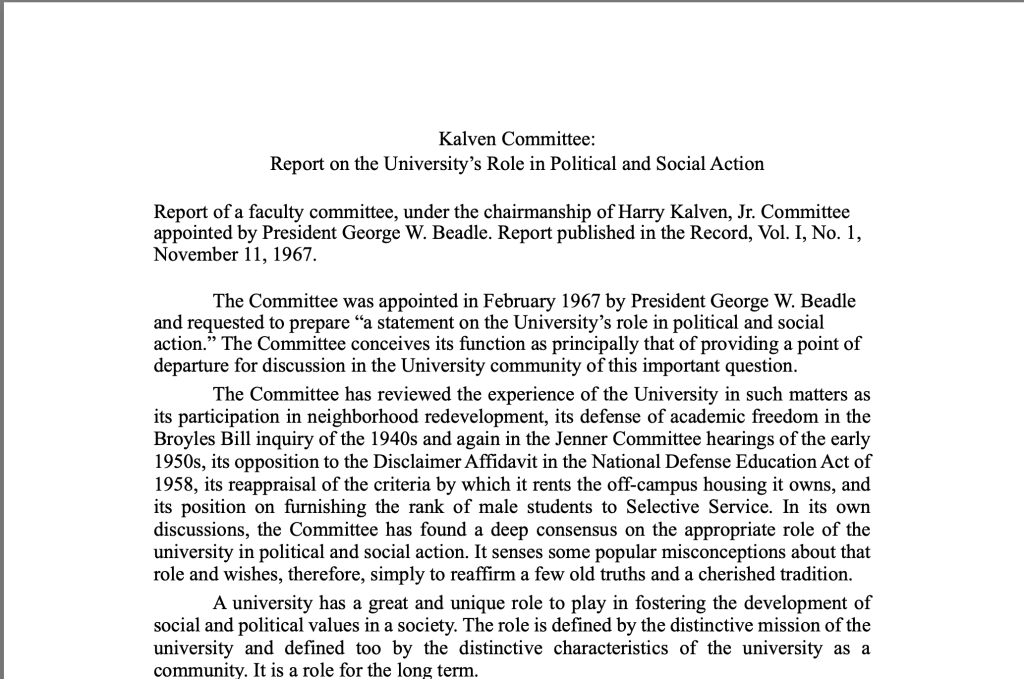
Chicago 1967 – where the latest debate began
While arguments about university statements have been taking place for as long as there have been universities, the origins of the current debate arguably begin with the Kalven Committee at the University of Chicago in 1967. The Committee’s Report on the University’s Role in Political and Social Action was very much a response to the challenges higher education was facing then at a time of huge political turmoil. The fundamental concept here is that universities should not take a position on anything because to do so is to stifle the voices who might not agree with that position. The arguments still remain current
This approach has remained influential and continues to be a reference point for those arguing for institutional neutrality.
Kalven stressed the importance of embracing a plurality of views:
A university, if it is to be true to its faith in intellectual inquiry, must embrace, be hospitable to, and encourage the widest diversity of views within its own community.
But he argued that this can only happen if the institution is neutral:
The neutrality of the university as an institution arises then not from a lack of courage nor out of indifference and insensitivity. It arises out of respect for free inquiry and the obligation to cherish a diversity of viewpoints. And this neutrality as an institution has its complement in the fullest freedom for its faculty and students as individuals to participate in political action and social protest.
Although the origins of the current debate lie in Chicago, the arguments about institutional neutrality actually go back a lot further. The University of Glasgow, back in the late 18th Century, had three professors who were actively involved in the Society for the Abolition of the Slave Trade and persuaded the University to submit two anti-slave trade petitions to Parliament as well as awarding an honorary degree to abolitionist William Wilberforce. Taking such a stand flew in the face of the views of city’s business leaders who were still profiting hugely from taking in slave-produced goods.
The legal and regulatory position in the UK
It has been hard to avoid the debates about freedom of speech and academic freedom in HE over recent years. The landmark development was the Higher Education (Freedom of Speech) Act of 2023. This Act, which is now in force, is an important reference point for the issue of institutional neutrality. Also relevant in this context is Article 10 of the European Convention on Human Rights, which guarantees the right to freedom of expression. In England, the OfS, expresses its regulatory requirements in this domain via Condition E1 which sets out that institutions have to uphold freedom of speech and academic freedom within the law as part of the public interest governance principles.
What does institutional neutrality actually mean?
The concept of institutional neutrality, as it is usually presented, embraces some or all of the following features:
- Universities should refrain from taking official positions on political or social issues that do not directly affect their core mission or academic functioning.
- In order to protect free speech, university leaders should not engage in speech that would appear to impinge on others’ speech.
- Universities should be a protected, neutral place for the expression of all ideas, a safe space for healthy disagreement and debate.
- The environment and atmosphere should foster speculation, experiment and creation.
The number of universities which have adopted statements professing institutional neutrality is not large. Despite claims by some that the position is becoming “mainstream” the number of universities in the USA seems to have stalled at just over 160 and in the UK appears still to be in single figures. However, more universities and colleges are certainly discussing the issue and a couple of examples from the small number of published positions in the UK give a flavour what such statements look like:
4.1. The University recognises freedom of speech and academic freedom within the law as foundation stones of its mission and therefore takes steps to secure and promote a free and open environment of academic debate where ideas will be robustly contested and challenged, and to promote a culture of tolerance of differing views within the law, including:
b) not taking an institutional position on political, cultural and religious debates to ensure that individuals are not discouraged from expressing themselves freely within the law;
Queen Mary, University of London, Code of Practice on Free Speech
The University and the Students’ Union both have charitable status, and in this area of the law too, they must be mindful of the conditions this imposes on freedom of expression. In particular, they must act according to their charitable purpose of furthering students’ education for the public benefit, and they must be politically neutral in their starting point, and refrain from actively promoting a particular point of view that is not tied to that general charitable purpose
University of Edinburgh statement on its Commitment to Freedom of Expression

Arguments for and against neutrality
Those who argue that institutions should adopt a neutrality policy make the case that this ensures that universities focus on their core business of teaching and research, avoid the division of adopting specific positions, and ensure there is no ‘chilling effect’ on free speech. It is this latter point which tends to be at the heart of the arguments in favour of the adoption of institutional neutrality positions. It is suggested that if an institutional position is a adopted on any issue then it makes it harder for anyone who disagrees with that position to speak up, ie the environment for free expression is limited and some people feel that they have their right to free speech curtailed.
Arguments against institutional neutrality include the proposition that, historically, universities, their staff and students have been in the vanguard of social change and promoted inclusivity by supporting marginalised groups – this should not stop now. Issues such as EDI, LGBTQ rights etc are elemental to what a university is as an inclusive community where difference and diversity whether it is in viewpoint or personal expression is embraced and respected. Universities have a duty to speak out on the big issues such as social justice as not to do so could be taken as complicity. Institutions will all be committed to free speech, equality and diversity and sustainability principles – speaking out on these matters reinforces institutional values.
Those in favour of institutional neutrality argue that any values-based judgements on investments are problematic. For example, Abhishek Saha, writing in the Times Higher, commented that:
choosing specifically to divest from certain companies (such as oil firms) because of their perceived malign actions risks aligning the institution with a particular political stance on climate change or corporate responsibility.
There is a debate to be had here on investments in energy firms – as regularly occurs in universities – but what about the other investments often ruled out by institutional policies such as those relating to gambling, tobacco and pornography or those companies with convictions for modern slavery practices? Presumably these should not be excluded as to do so is to breach neutrality on such issues?
Universities as communities
Part of the argument here is that the institution is not an institution other than being a collection of individuals living under the same roof. It denies the collective in favour of the primacy of the individual and stresses that the individual voice matters more. It actually undermines the notion of the university as a community by reducing it to a collection of free-spirited, free-speaking individuals. Who all enjoy, in a UK context, the protections of academic freedom. Already enshrined in university charters and other governing documents and now reinforced further in law, academics have the freedom to speak out in a way which offers protections that many others do not have. And yet it is this group who it seems are most at risk of being stifled (and at this point anyone who works in a university who has ever been in a university faculty meeting will start to question how chilly does it have to get to see a chilling effect on a debate).
But universities are communities – they are not only communities of scholars, they are communities embracing other professional staff, administrators and technicians, cleaners and caterers. But students too, many, many students who also have their views on the issues of the day. It is this genuine inclusive university community, in all its diversity, we need to consider when talking about institutional neutrality.
Before deciding whether to follow the small number of institutions which have published a statement, executive boards and governing bodies will want to have a full and wide-ranging discussion on the issues. This might include full consideration of institutional history, previous experiences and existing strategy and policies, to ensure that leaders are aware of how the adoption of such a policy will land with their community.
Back in 2025 the American Association of University Professors, the AAUP, published a clear statement on this issue which concluded:
A university’s decision to speak, or not; to limit its departments or other units from speaking; to divest from investments that conflict with its mission; or to limit protest in order to promote other forms of speech are all choices that might either promote or inhibit academic freedom and thus must be made with an eye to those practical results, not to some empty conception of neutrality. The defense of academic freedom has never been a neutral act.
In the context of the second Trump administration’s numerous assaults on academic freedom in higher education, the AAUP urges universities, whose educational mission is to serve the public good, not to hide behind the pretense of remaining neutral.
This strikes me as being a sensible stance to take. The positions adopted and policy decisions taken by a university over decades are baked into the culture and fabric of the institution – they are part of its identity, the myths and legends, the ways of operating. Of course, many staff, past present and future, may disagree with some or most of these positions. Academic staff are free to argue with all or any of this and frequently do. This is part of what makes a university a university.

Just chillin‘
The much referred to ‘chilling effect’ of institutional positions on matters with which some disagree is vastly overstated. Especially when one looks at the impact of government intervention on academics and others at universities in the US who have had the temerity to speak up on social issues. It is not universities chilling anything here it is an intolerant US President and his allies looking to stamp on opposition – a genuine Arctic blast. And that is the real issue then for UK universities – if they adopt a position of institutional neutrality then what are they going to say if there is a populist government in Britain looking to challenge higher education?
Those most in favour of neutrality often want to prevent support for causes they do not agree with, even if these are fundamentally aligned to the core purpose of a university. As Jonathan Grant put it in an article for Wonkhe in 2024:
it is in the interest of the populist to argue for institutional neutrality of universities. This allows their post truth/evidence free policies to go unchallenged. It is not an accident that universities are portrayed as ‘woke’ institutions that are out of touch with the “will of the people” on matters such as diversity, equity and inclusion, net zero or gender rights.
Neutrality has not helped US universities escape Trump’s ire and it is unlikely to work in the UK either. Institutional neutrality does need to be discussed within universities but I remain convinced that they will conclude that it is not only not in their best interests it runs counter to their core purposes.


Leave a Reply