Is it time to focus more on what students say they need?
There is much of interest in the latest HEPI/AdvanceHE student academic experience survey, covering a range of student issues and launched at the HEPI Annual Conference on 11 June 2026. The findings in the survey relating to free speech were particularly striking. Essentially, they suggest that the majority of students are happy expressing their views, even if others disagree. But for those who do not feel so comfortable, the reasons do not fit the current narrative relating to cancellation or a “chilling effect.”
The survey
This is a big survey involving over 10,000 students and has been undertaken annually since 2005-06. It covers a wide range of student academic experience issues, including teaching intensity, teaching quality and assessment, wellbeing and the impact of geography on the student experience. It also surveyed students on their views on belonging and free speech.
Feeling comfortable
The survey reports that:
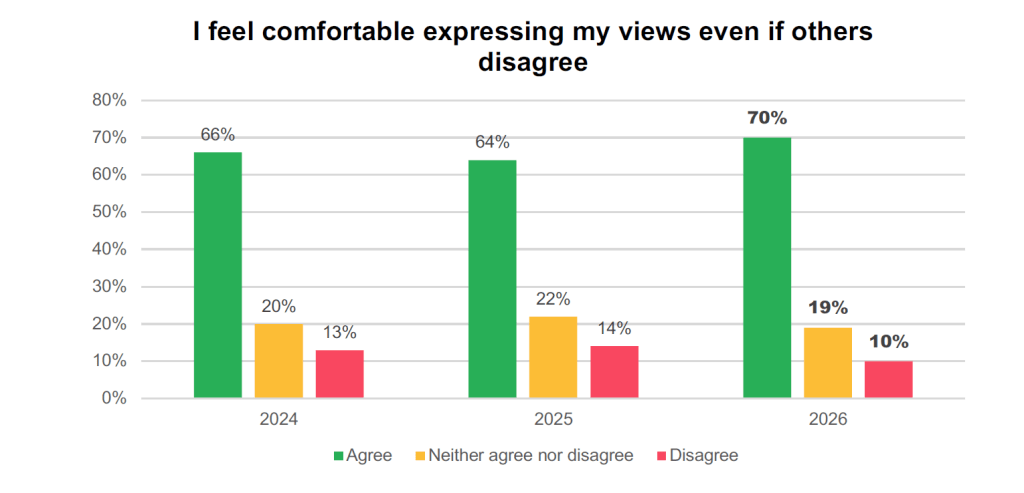
Seven out of ten students feel comfortable expressing their views on campus, which is a six percentage-point (statistically significant) increase since 2025. This has been mirrored by a clear decline in the proportion who disagree with this statement, representing a generally positive picture.
There are variations among the students responding which are also interesting:
Age seems to be a factor here, with 76% of students aged 26 or older feeling comfortable expressing their viewpoints compared to 71% of students aged 22-25 and 67% aged 21 and under. In addition, 74% of international students felt comfortable expressing their viewpoint compared to sixty-nine % of home students. However, students with a disability were significantly more likely to disagree with the statement ‘I feel comfortable expressing my views even if others disagree’, with 14% of students with disabilities doing so compared to 8% of students without a disability
This is really positive news then. Although there is work to be done, especially with groups where the lower confidence levels are found, this is a strong base to start from. It feels a very long way from all of stories of a ‘chilling effect’ and student free speech being widely constrained.
Feeling uncomfortable
The survey responses in relation to what makes students feel uncomfortable expressing their views are a real eye-opener:
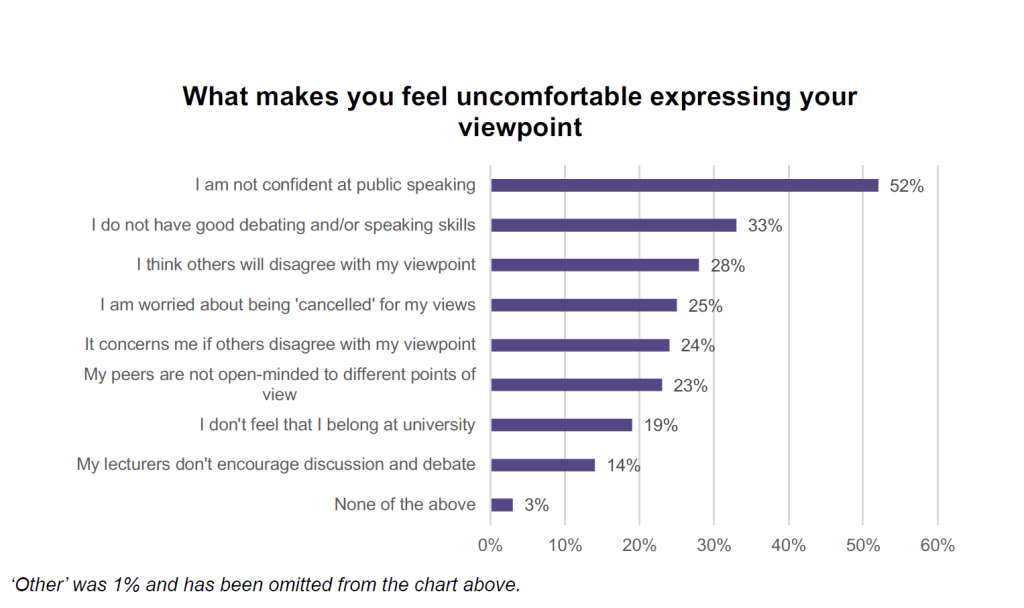
It seems then that the two biggest reasons why students are uncomfortable expressing their viewpoints are based on personal factors: a lack of confidence in public speaking and the feeling they did not have good debating and/or public speaking skills.
Interestingly, this is a little different for privately educated students:
Students who attended a private school were significantly less likely (36% for those who attended private school versus 55% for those who attended a state school) to say that a lack of confidence in public speaking made them uncomfortable in expressing their viewpoint. Similarly, when asked what made them more comfortable expressing their viewpoint, 37% of students who attended private school selected confidence in public speaking as a reason, compared with 28% of those who attended a state school.
If, as this survey suggests, the principal reason don’t speak up is anxiety about public speaking and that this is much more significant than the fear of cancellation or disagreement then this does challenge many of the assumptions which have underpinned the free speech legislation and OfS regulations.
Legislating for the wrong thing?
Perhaps then the legislation and whole free speech framework has been concerned with the wrong target. We now have a significant higher education free speech architecture (for England) to ensure institutions secure and promote free speech and a complaints scheme for those unhappy is forthcoming. This is a major area of work for the OfS which is already having to rethink its approach after the Sussex judgment and there are regular reminders when discussing free speech about the so-called chilling effect too.
But what this survey has shown is that there is a much bigger issue here – many students are simply anxious about speaking in public and concerned about their debating skills. These are issues which institutions are extremely well-placed to address and surely we should be focusing on that first. If we can ensure all students have the necessary skills and are confident to speak and debate then we can see if there is really a problem still with this core area of free speech on campus.
Responding to the findings
The report’s first recommendation on this issue is that
Institutions should consider developing, encouraging and assessing public speaking in all higher education programmes. These programmes would need to consider that some students are extremely anxious about public speaking and be tailored to support students in developing their skills in a supportive environment at their own pace. Done well, this could increase students’ confidence and help develop a vital employability skill.
This may well be pushing at an open door. In addition to presentation and debating skills built into curricula, many institutions offer study skills and academic literacy programmes which include speaking and presentational skills. It really does seem that these need to be really ramped up but there is a solid foundation to build upon.
Time for a rethink on free speech regulation?
Josh Fleming, the interim CEO at the OfS (for a few more days until his permanent successors take over), commented on this issue at the HEPI Annual Conference and proposed that this is all very much something which will be addressed as part of the ‘Promote’ element of the free speech programme due in the near future. However, if all that has gone before has been focused on the ‘Secure’ element of free speech this does rather suggest that all regulation to date might have been focusing on the wrong thing. He also noted that the OfS was currently working hard revising the free speech advice in the light of the Sussex judgment so perhaps they do need to broaden the scope of that work to reflect on the wider issues raised by these striking findings.
Although there is a second free speech recommendation in the report that the OfS should consider issuing more advice in relation to promoting speaking and debating skills, really what is needed is for them to intensify their current review and perhaps look at removing some of the existing advice. As it really does sound like all the effort, rules, regulations and legislation might have been directed at the wrong target.


Leave a Reply