
Higher education regulation in England is far too expensive
A recent THE article noted that many in the English higher education sector were sceptical about the Department for Education’s (DfE) consultation on fees charged by the Office for Students (OfS). There was a strong feeling that tweaks to the structure of fees do not address the core issue here – the full cost and burden of the OfS regulatory regime – and that a full overhaul, which better holds the regulator to account, was required:
“Our view is that any changes to the Office for Students’ fee model must start with a more fundamental question about value for money,” said Susanna Kalitowski, director of policy at University Alliance.
Kalitowski added: “Before introducing new charges or restructuring the fee model, the OfS should demonstrate greater transparency, efficiency and accountability for how those fees are spent.
“Ultimately, we must remember that these costs are funded through students’ tuition fees. Every pound spent on a growing regulatory bill is a pound that could be invested in teaching, student support or the staff who deliver an excellent student experience.”
(And there is also a bonus comment from me in there too.)
Unlike the situation which existed before the 2017 Higher Education and Research Act, the cost of the sector regulator has to be met by registered institutions rather than government so all are charged fees by the OfS to cover its costs. The Department for Education (DfE) makes a contribution but the bulk of the OfS’ funds come from fees paid by universities and colleges.
How much money does the OfS need?
The Annual report and accounts for the Office for Students for 2025-26 offers some clarity on this issue and, as the report notes, the majority of the OfS’ costs relate to people:
Most of our operating costs relate to staff. Other significant areas of expenditure are premises and office costs, including IT. The OfS’s total operating costs in 2025-26 were £51.0 million (2024-25: £41 million re-presented).
Roughly 80% of that operating expenditure is staff related. Unsurprising perhaps.

Staff numbers
In Fit for the Future: Independent Review of the Office for Students, also known as the Behan report, published in July 2024, we were informed about the growth in OfS staff numbers:
The increasing asks made of the OfS have resulted in its full-time equivalent (FTE) staff count growing from 367 in 2018 to 490 in 2024 (an increase of 34%). Despite this increase, according to Cabinet Office and HMT analysis benchmarking of the efficiencies of arms’ length bodies, the OfS is generally considered to be at benchmark for most functions and activities in comparison to other arms’ length bodies in its comparison group.
Where we are now, according to the annual report, is that as at the census date of 31 March 2026, the OfS employed 523 full-time equivalent staff (2024-25: 475) with this representing 553 individuals employed (2024- 25: 503). This represents a 42% increase in FTE staff since 2018.
Based on the organisational model described in OfS publications, staff are concentrated in:
- Regulatory and quality assessment teams.
- Access, participation and student interest teams.
- Financial sustainability and provider risk teams.
- Data, analytics and reporting functions.
- Corporate services (HR, finance, legal, communications, digital and administrative support).
There is little more detail than this publicly available though and it is not possible to discern from the OfS website how many staff work in each area or indeed who they are. There are a few more senior staff highlighted than there used to be, along with the top leadership team, but beyond this there are still very many staff, along with their organisational disposition, completely invisible to all. There may, of course, be particular justification for this or a good policy rationale. However, this is not how the vast majority of higher education institutions operate and it does feel somewhat at odds with the regulator’s ambitions for transparency.
One other reference point regarding staff numbers- 553 staff is around 200 more than HEFCE had in 2016 and roughly equivalent to the combined total staff complement of HEFCE and QAA in 2016.
A regulatory bargain?
As presented by the OfS, in 2025–26, at sector level, the registration fees paid by universities and colleges to the OfS amounted to around 0.1 per cent of the income they are able to access by virtue of being registered with the OfS. A bargain!
Let’s break this down a little further as it does seem rather at the lower end of what you might expect for an answer if you asked, say, the average professor in the street what proportion of institutional funds was redirected to the regulator.
As calculated by the OfS this is total OfS registration fees received from institutions for the 2025-26 financial year end (£32,462,796) divided by total registration-contingent income for the 2024-25 academic year (£31.6 billion):
In the 2024-25 academic year, the registration-contingent income received by registered providers in England comprised approximately £10.8 billion through student loans for tuition fees, £10.6 billion in course fees from international students, and £10.2 billion of registration contingent research and other public funding.
The annual report includes this exciting graphic to illustrate this and some broader points about institutional numbers and students taught:
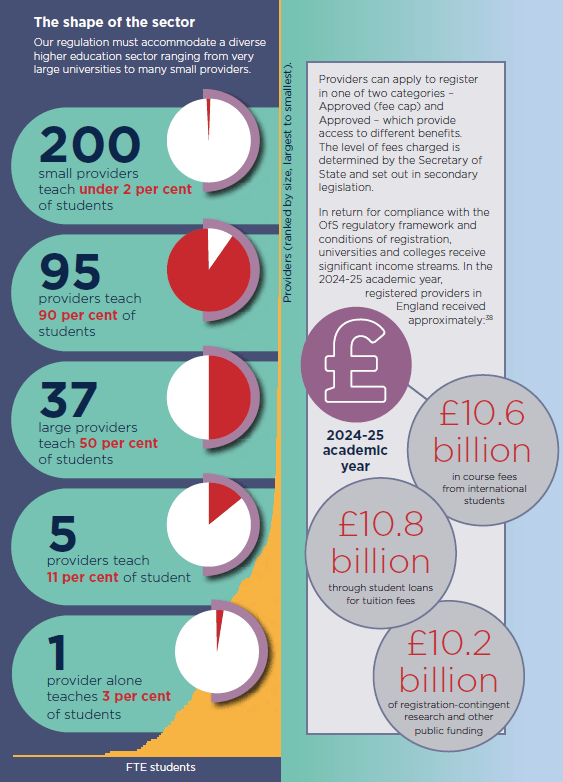
In other words, if you weren’t registered with the OfS, you might save yourself a couple of quid but you would have missed out on a big share of untold riches – your portion of nearly £32 billion which is just waiting for eager finance directors to take delivery. I must admit to not being wholly convinced that everyone’s institutional share of the £32 billion prize fund is principally down to the existence of the regulator above any actions they might be required to undertake themselves.
Another fun reference point for you – the total fees charged by the OfS to institutions add up to just slightly more than the annual turnover of Norwich University of the Arts.
Savings and efficiency
The OfS did make some efficiencies during the year and, according to the financial statements, the agency hit its £1.2 million cost saving target.
This was achieved
mainly through IT driven efficiencies, reduced dependence on external firms to conduct detailed provider financial sustainability reviews, and organisational rationalisation. We have reinvested the savings in our core regulatory activities Achieving efficiencies is part of a multi-year programme. We intend to achieve this through exploration of AI utilisation in our core processes and other targeted reviews of our processes. We intend to primarily reinvest this in core regulatory activities
Even more regulation activity for your regulatory pound.
Yet another exciting data point, that £1.2 million represents just over 2.4% of operating costs. This looks rather different to the levels of savings being sought by many institutions.
It’s not all good financial news though. The outcome of the judicial review into the OfS’ actions in relation to the University of Sussex must have had an impact. As the report puts it:
While the recent judgment in the University of Sussex judicial review broadly endorsed the approach set out in our guidance, some aspects will need to be updated, to make sure there is clarity as preparations continue for the launch of the complaints scheme. We will engage with the sector as this work is taken forward.
I’m not sure all of those looking at the outcome of this case would see it as broad endorsement for the regulator’s approach. Moreover, the accounts show that the OfS had to make a provision of £600,000 for legal costs incurred by Sussex.
Unfortunately, the cost of this provision wipes out half of the cost savings reported above. It’s not clear whether further savings will be made to cover this unexpected bill or indeed what incentives the regulator has to make any efficiencies at all given that it can just increase the fees charged to institutions to cover additional costs.
Key Performance Measures
The OfS Annual Report also sets out progress made against a series of Key Performance Measures (KPMs). Unfortunately, these do not really seem to focus on matters which really highlight the regulatory burden or cost efficiency.
Four particular examples are worth noting here.
Quality investigations
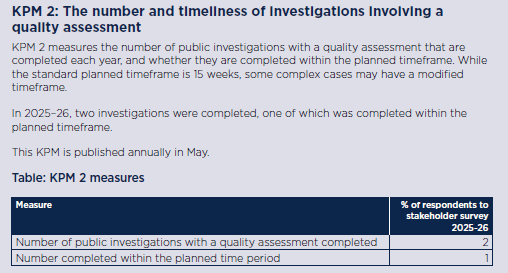
KPM 2 covers the number and timeliness of investigations involving a quality assessment:
KPM 2 measures the number of public investigations with a quality assessment that are completed each year, and whether they are completed within the planned timeframe.
This does not look terribly impressive as a KPM
There is more though, although this is not captured by the KPM:
We published three case reports setting out our views on provider compliance with our quality conditions and the further action we have taken.
Awareness of the OfS
The OfS, unsurprisingly perhaps, regards its profile among those on whose behalf it regulates as a matter of some importance.
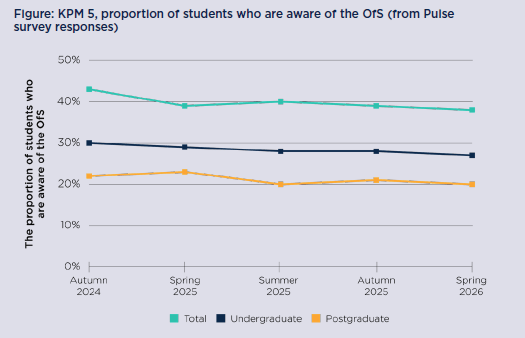
KPM5 covers this but unfortunately I can’t see how a higher proportion of students overall is aware of the OfS than the proportions of undergraduates and postgraduates.
Visits to institutions
Getting out and about, meeting the regulated and their students, is really important for all OfS staff and should be seen, I would suggest, as a KPM for all 550 employees. It is hard really to understand the impact of the work of the OfS without actually engaging with institutions, their staff and students. Unfortunately, KPM6b shows that the total of non regulatory visits between April 2025 and March 2026 was only 46, ie fewer than one a week across the whole agency. This is I think an improvement on previous years but really feels like an area where there is a need to try much, much harder.
Key performance measure 9
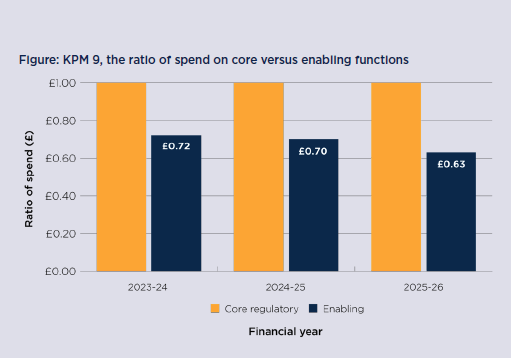
KPM9 is about categories of OfS expenditure and compares spending on what are described as core regulatory activities and enabling activities:
We measure variation in spending by comparing expenditure on core regulatory activities (such as the work of our Regulation Directorate and legal team) with expenditure on enabling functions (such as human resources and finance). This is measured by dividing spend on enabling functions by spend on core regulatory functions. KPM 9 tracks the shape of the organisation by providing a high-level indication of how effectively resources are aligned to the organisation’s primary regulatory functions. There is a downward trend in enabling spend relative to core regulatory spend. Over the period shown, for every £1 spent on the front line, proportionately less is being spent on enabling functions, demonstrating a shift in the balance of expenditure towards priority work.
Interestingly, the OfS legal team is viewed here as part of the core regulatory function – this might look surprising to some. However, we still have no idea about the details of the staff numbers or units involved in each category so it is hard to make much of this KPM.
Other nuggets from the annual report
There were a couple of other points of interest in the annual report for me. First, FOI:
The volume and complexity of Freedom of Information requests have continued to increase. In the 2025-26 financial year we received 155 requests
This feels like a surprisingly low number, only 3 a week. Many universities will be having to deal with at least 5 or 10 times as many as that.
Secondly, there is the popularity of the OfS advice on free speech:
In June 2025, we published Regulatory Advice 24 (RA24), providing detailed guidance to support compliance. Since publication, the guidance has been accessed from our website over 34,000 times, demonstrating strong sector engagement.
The bulk of the iceberg
In 2024 Moorhouse Consulting produced an insightful report for Universities UK which included a detailed survey of the cost and burden of different aspects of the OfS regulatory regime to the English sector. Among other things the report noted that the resources required to understand and meet regulatory requirements were significant as were the opportunity costs of the regulatory burden for universities. Although the immediate cost of funding the OfS is significant, in fact the additional real cost to institutions is much, much higher.
In assessing the direct cost of the OfS regulatory regime the consultants collected data on the number of staff involved. The Moorhouse estimate of the total numbers dedicated to regulatory matters show that the institutional investment in addressing such matters really is not trivial:
We estimate that this would be 128 FTE at Executive level, 638 FTE at Manager/Director Level and 1,288 at Officer/Coordinator level dedicated solely to regulatory compliance across all 116 UUK members in England. Universities typically do not have dedicated regulatory teams; this resource is incorporated as part of existing roles.
So this is over 2,000 senior and very senior staff FTE across England’s universities. The total cost of this will be of the order of £150-200m per annum. Of course some of this will remain necessary, and it is possible that some of these roles have been removed or staff redeployed as part of major institutional restructurings currently underway, but there is major scope for savings/redeployment here were the current regulatory regime to be radically adjusted.
Outstanding issues
The OfS funding model remains fairly opaque below the surface. While it is clear where the money comes from (principally those regulated fee payers), the destination of large payments (over £25k), expenses paid to staff and the board and it is clear that 80% of expenditure is on staff costs, the real cost of the regulatory framework is not clear. The reality though is that the biggest regulatory cost by some distance falls on institutions which have to comply with the OfS’s requirements and this is simply not recognised within the funding model.
Value for money is therefore very hard to establish. Looking at the agency’s limited range of key performance measures there is no sense in any of these about the real cost and value of the regulatory activity undertaken, the benefit for students or the cost and burden for institutions. It would be difficult therefore to describe any of this as transparent or fair.
Time for a rethink
The OfS fee structure requires a major reassessment to address the value of the regulatory model and the regulatory burden on institutions before determining an appropriate split of fees between government and institutions, and an appropriate level of fee.
It really is time for a rethink. As I have set out here before there is an approach which would significantly reduce the regulatory burden on institutions. As it stands though, the volume of regulation keeps growing and registered institutions are required to pick up the tab, whatever the cost. In the short term then the larger part of the cost of regulation should be met centrally by DfE and the balance by institutions. Where increases in funding are required then these should have to be justified to and met by the DfE, which should always be considering means of reducing the regulatory burden. Where we are now though is that those regulated really can’t argue against the costs of regulation because the decision-maker is also the regulator. This has to change.
There needs to be a great deal more transparency about the cost of the OfS regulatory set up, better KPMs and an explicit target to reduce the burden of regulation and the cost to institutions.


Leave a Reply