Revisiting QA way back then
There’s nothing quite like someone commenting on something you wrote 25 years ago for making you feel really, really old. Nevertheless, I am hugely grateful to Roscoe Hastings for writing a piece for Perspectives referring to an article I wrote for the same journal back in 2001. Hastings’ piece neatly compares the quality assurance regulatory environment I presented back in 2001 with where we are today and highlights some interesting parallels.
He argues that in the post-HERA world that there are three main tensions which continue to drive quality assurance arrangements: legitimacy v responsiveness; marketisation v quality culture; and evidence v trust.
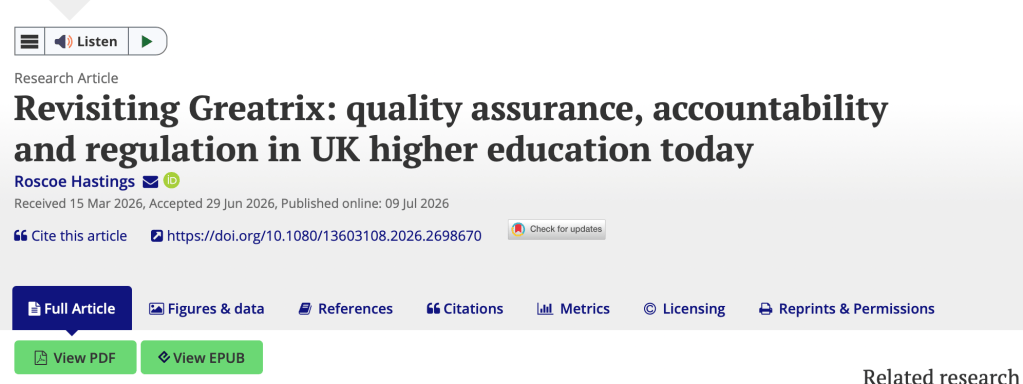
Among his conclusions is the insightful observation that:
contemporary regulatory reforms risk continuing to reinforce a command-and-control approach that threatens institutional autonomy, unless institutional governance and evaluative capacity are strengthened.
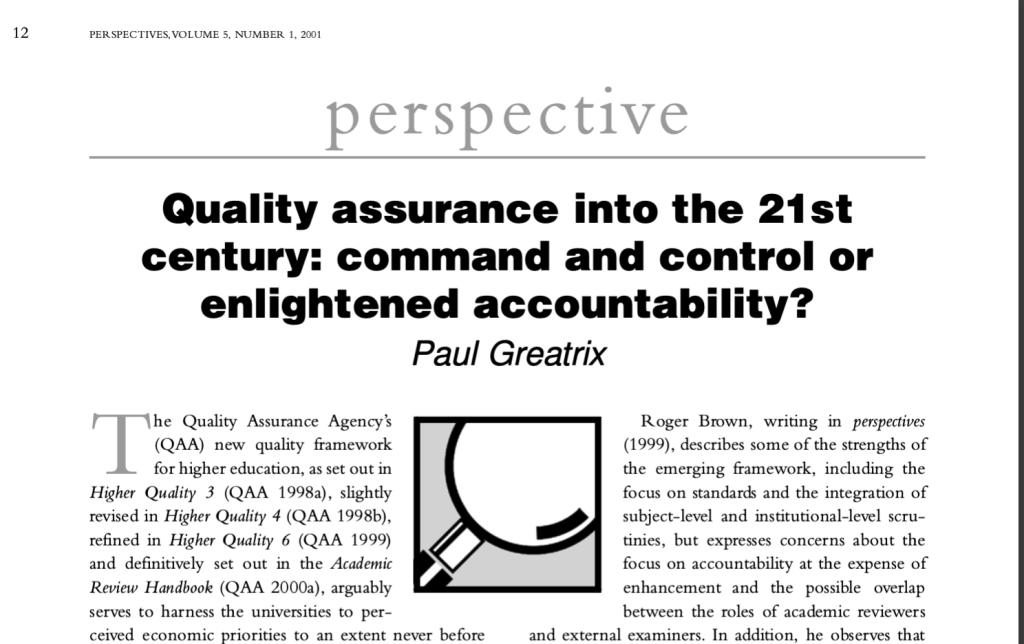
Hastings draws a number of parallels between the QA position in 2001 and where we are in 2026 and, in hindsight, the situation at the beginning of the century now looks a little more benign than it felt at the time. He provides a very helpful summary of the arguments I presented back then:
Greatrix argued that during this time of change, UK QA was increasingly being shaped by managerial and regulatory approaches that emphasised external control, procedural compliance, and audit-based accountability. His central argument concerned expanding state oversight and formal QA mechanisms that risked creating a ‘command-and-control’ culture in which institutions became preoccupied with satisfying regulatory requirements rather than genuinely enhancing educational quality. Greatrix contends that such systems can encourage bureaucratisation, standardisation, and performative compliance, potentially weakening academic autonomy and reducing the capacity for innovation and self-critical reflection within universities. Against this, he proposes the concept of ‘enlightened accountability’, a model in which institutions remain publicly accountable but retain ownership of quality enhancement through collegial governance, peer review, and internally embedded quality cultures. He argues that effective QA should be developmental rather than punitive, relying on trust, professional responsibility, and evidence-informed self-evaluation rather than excessive external prescription. The article, therefore, presents quality assurance as a balance between accountability and autonomy, warning that over-regulation may ultimately undermine the very culture of improvement that QA systems seek to promote.
It could be said that, one way or another, I have been ploughing pretty much the same furrow ever since.
Hastings covers the major changes in the regulatory environment since 2001 including the big reviews from Browne and Augar and, crucially, the 2017 HERA, which abolished Hefce, established the OfS and created the TEF. The TEF is a global assessment of teaching quality based on data and a written submission rather than inspections and huge volumes of paperwork but is equally lacking in value.
Further growth in the regulatory burden
Things have changed for sure since 2001 but not for the better:
Greatrix’s characterisation of the proposed changes in the early 2000s as seeing a ‘significant diminution of the position of the academy’ (14) is further reinforced in the context of today with further erosion of peer- led, collaborative and consensual approaches to QA (Ashwin and Clarke 2022; Lapworth 2022) and an increasing move towards approaches that can be more easily monitored (Shattock and Horvath 2020). In the words of Shattock and Horvath, this represents ‘almost the ultimate in state micro-management’.
It’s not about addressing quality and the burden is growing

The QA tensions
Hastings revisits and explores the three main tensions he identifies in the 2001 paper:
The tensions identified by Greatrix in his discussion of QA models remain important for understanding developing approaches today. Although the regulatory context in which his argument was framed has changed significantly as discussed above, the underlying dynamics between oversight, institutional autonomy, and quality culture continue to shape policy and practice. In today’s regulatory context, three interrelated tensions are particularly visible:
- legitimacy versus responsiveness,
- marketisation versus quality culture, and
- evidence versus trust.
He argues that each of these reflects an ongoing argument or negotiation between regulatory authority and institutional autonomy.
Where does QA go from here?
Hastings sets out a way forward which manages these tensions and sees a
regulatory framework that combines legitimate public accountability with institutional responsiveness, balances market incentives with robust governance, and integrates evidence with trust-based professional and academic practice is most likely to sustain the quality and credibility of UK higher education in the decades ahead. Therefore, we should not see these as hard binaries but be mindful of how we seek to manage these paradoxes in our approach to QA.
A negative prognosis
The original paper certainly set out a rather gloomy analysis and prospectus. Hastings acknowledges that he is presenting a similarly negative prognosis. The changes underway now are building on and repeating the faults of the previous era. He concludes by noting that the government’s 2025 Post-16 Education and Skills White Paper contains 132 references to quality and includes plans for the OfS to review degree algorithms and the external examiner system. As he puts it:
Both of these points talk to a greater move towards standardisation and a further erosion at best, or assault at worst, on institutional autonomy.
The persistence of these tensions suggests that the core challenge of UK quality assurance has remained remarkably stable: how to reconcile public accountability with the professional autonomy on which academic quality ultimately depends. It will be interesting to see what commentators will say in a future edition of Perspectives when they look back on the changing nature of QA in the next 25 years. Will the same arguments be made, or is change really on the horizon this time?
25 years is a long time in the real world but even longer in higher education regulation.
Finally…
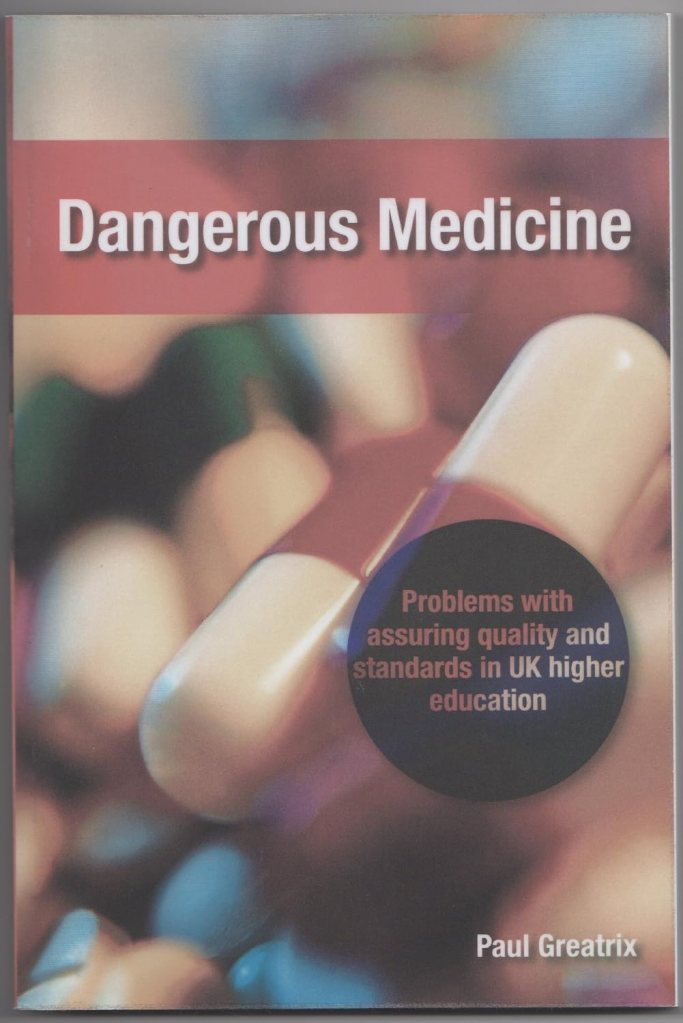
Thank you Roscoe for writing this very good piece. My article was originally produced as part of my PhD and it certainly helped me along the way. The good news is that if this kind of thing really excites you then it is possible to read about it at much greater length in Dangerous Medicine, the book of the thesis, which is still available for Kindle at a very reasonable price.
All of which leaves me feeling quite a bit older but no wiser. I was pessimistic back then, and am even more so today. Good luck everyone.
Reference
Hastings, R (09 July 2026), ‘Revisiting Greatrix: quality assurance, accountability and regulation in UK higher education today’, Perspectives: Policy and Practice in Higher Education, DOI: 10.1080/13603108.2026.2698670.


Leave a Reply